
 admin
admin “Geometry is not just about shapes—it is the art of logical reasoning. Every theorem is a powerful tool that helps us understand the world through patterns, relationships, and proofs.”
Geometry is one of the oldest and most beautiful branches of mathematics. From the pyramids of Egypt and the architecture of ancient Greece to modern engineering, computer graphics, robotics, and space exploration, geometry plays a fundamental role in solving real-world problems.
Yet for many students, geometry becomes a subject filled with theorems to memorize rather than ideas to understand.
One of the biggest misconceptions in learning geometry is believing that success comes from remembering dozens of theorems. In reality, a handful of core theorems form the foundation for nearly every geometry problem encountered in school mathematics, Olympiads, standardized tests, and university entrance examinations.
In this article, we’ll explore the most essential geometry theorems every student should know, understand why they work, and see how they appear in mathematical problem-solving.
Why Are Geometry Theorems Important?
A theorem is a mathematical statement that has been rigorously proven using logical reasoning.
Unlike formulas that may simply be applied, theorems explain why geometric relationships always hold.
Understanding these results enables students to:
- Solve unfamiliar problems.
- Construct elegant proofs.
- Recognize hidden relationships.
- Develop logical reasoning.
- Build confidence in mathematics.
Rather than memorizing isolated facts, students should aim to connect these theorems into one coherent framework.
1. The Angle Sum Theorem
One of the first theorems students encounter is:
The sum of the interior angles of a triangle is always 180°.
This simple result underpins countless geometry problems.
It allows us to:
- find unknown angles,
- prove parallel lines,
- analyze polygons,
- establish congruence.
Once this theorem becomes second nature, many seemingly difficult angle-chasing problems become straightforward.
2. Exterior Angle Theorem
The exterior angle of a triangle equals the sum of the two opposite interior angles.
Instead of calculating three angles separately, this theorem often provides the shortest solution.
It appears frequently in:
- school examinations,
- SAT,
- ACT,
- IGCSE,
- IB Mathematics,
- Olympiad geometry.
3. Isosceles Triangle Theorem
If two sides of a triangle are equal, then the opposite angles are equal.
The converse is equally important:
If two angles are equal, then the opposite sides are equal.
Recognizing isosceles triangles often unlocks otherwise hidden relationships within a diagram.
4. Congruence Theorems
Congruence establishes that two figures are identical in size and shape.
Students should master:
- SSS (Side–Side–Side)
- SAS (Side–Angle–Side)
- ASA (Angle–Side–Angle)
- AAS (Angle–Angle–Side)
- RHS (Right angle–Hypotenuse–Side)
Congruence is the backbone of geometric proofs.
Whenever two triangles can be shown congruent, every corresponding angle and side immediately becomes available.
5. Similarity Theorems
Similarity is arguably more powerful than congruence because it introduces proportional reasoning.
The three primary criteria are:
- AA
- SAS Similarity
- SSS Similarity
Similarity appears throughout:
- trigonometry,
- coordinate geometry,
- calculus,
- engineering,
- physics.
Many Olympiad problems reduce to identifying similar triangles.
6. Pythagoras’ Theorem
Perhaps the most famous theorem in mathematics,
[
a^2+b^2=c^2
]
connects the three sides of a right triangle.
Its applications extend far beyond geometry.
It appears in:
- coordinate geometry,
- vectors,
- distance calculations,
- physics,
- computer graphics,
- machine learning.
Understanding why it works is far more valuable than merely memorizing the formula.
7. Converse of Pythagoras’ Theorem
If
[
a^2+b^2=c^2,
]
then the triangle must be right-angled.
This theorem helps classify triangles using only side lengths.
It is frequently tested in competitions.
8. Circle Theorems
Circle geometry is rich with elegant results.
Students should know:
- Angles in the same segment are equal.
- Angle subtended by a diameter is 90°.
- Radius is perpendicular to a tangent.
- Tangents from an external point are equal.
- Opposite angles of a cyclic quadrilateral sum to 180°.
- Angle at the center equals twice the angle at the circumference.
Many geometry questions involve combining several circle theorems simultaneously.
9. Midpoint Theorem
The segment joining the midpoints of two sides of a triangle:
- is parallel to the third side,
- has half its length.
This theorem appears frequently in coordinate geometry and vector proofs.
10. Basic Proportionality Theorem (Thales’ Theorem)
If a line is drawn parallel to one side of a triangle, it divides the other two sides proportionally.
This theorem forms the basis of:
- similarity,
- scaling,
- geometric constructions.
11. Intersecting Chords Theorem
If two chords intersect inside a circle,
the products of their segments are equal.
Likewise,
students should know the corresponding tangent–secant and secant–secant theorems.
These results often appear in advanced geometry and Olympiad problems.
12. Ceva’s Theorem
Ceva’s Theorem provides a criterion for determining when three cevians are concurrent.
Although rarely taught in standard school courses, it is indispensable in mathematical Olympiads.
Understanding Ceva opens the door to elegant synthetic geometry.
13. Menelaus’ Theorem
The dual counterpart to Ceva’s Theorem,
Menelaus’ Theorem determines when three points are collinear.
Together, Ceva and Menelaus form the foundation of advanced Euclidean geometry.
14. Stewart’s Theorem
Stewart’s Theorem relates the lengths of the sides of a triangle to the length of a cevian.
It provides a powerful alternative when coordinate geometry is unavailable.
Students preparing for Olympiads and university entrance examinations should become comfortable applying this theorem.
15. Euler’s Line
One of the most beautiful discoveries in triangle geometry is that the:
- centroid,
- circumcenter,
- orthocenter,
all lie on a single straight line.
This remarkable result illustrates the elegance hidden within seemingly simple triangles.
16. Nine-Point Circle
Every non-equilateral triangle possesses a unique circle passing through:
- the three side midpoints,
- the three feet of the altitudes,
- the three midpoint segments joining each vertex to the orthocenter.
The Nine-Point Circle is one of the crown jewels of Euclidean geometry.
Understanding Is Better Than Memorizing
Many students attempt to memorize geometry theorems individually.
A better strategy is to understand:
- why the theorem works,
- when it applies,
- how it connects to other results,
- how to recognize situations where it can simplify a problem.
When students understand these relationships, geometry becomes logical rather than mechanical.
How to Master Geometry Theorems
Instead of reading theorems repeatedly, try this approach:
1. Draw Every Figure
Geometry is visual.
Always sketch diagrams yourself.
2. Prove Theorems Independently
Reconstruct the proof without looking.
This develops genuine understanding.
3. Solve Diverse Problems
Apply each theorem to many different contexts.
Recognition improves through exposure.
4. Connect Different Theorems
Many geometry problems require multiple results simultaneously.
Learning how theorems interact is far more valuable than learning them separately.
5. Review Regularly
Geometry is cumulative.
Frequent revision prevents forgetting.
Why Geometry Matters Beyond School
Geometry is everywhere.
It underpins:
- Architecture
- Civil Engineering
- Mechanical Engineering
- Robotics
- Artificial Intelligence
- Computer Vision
- Animation
- Aerospace Engineering
- Navigation Systems
- Medical Imaging
- Virtual Reality
- Game Development
The logical reasoning developed through geometry is just as valuable as the mathematical content itself.
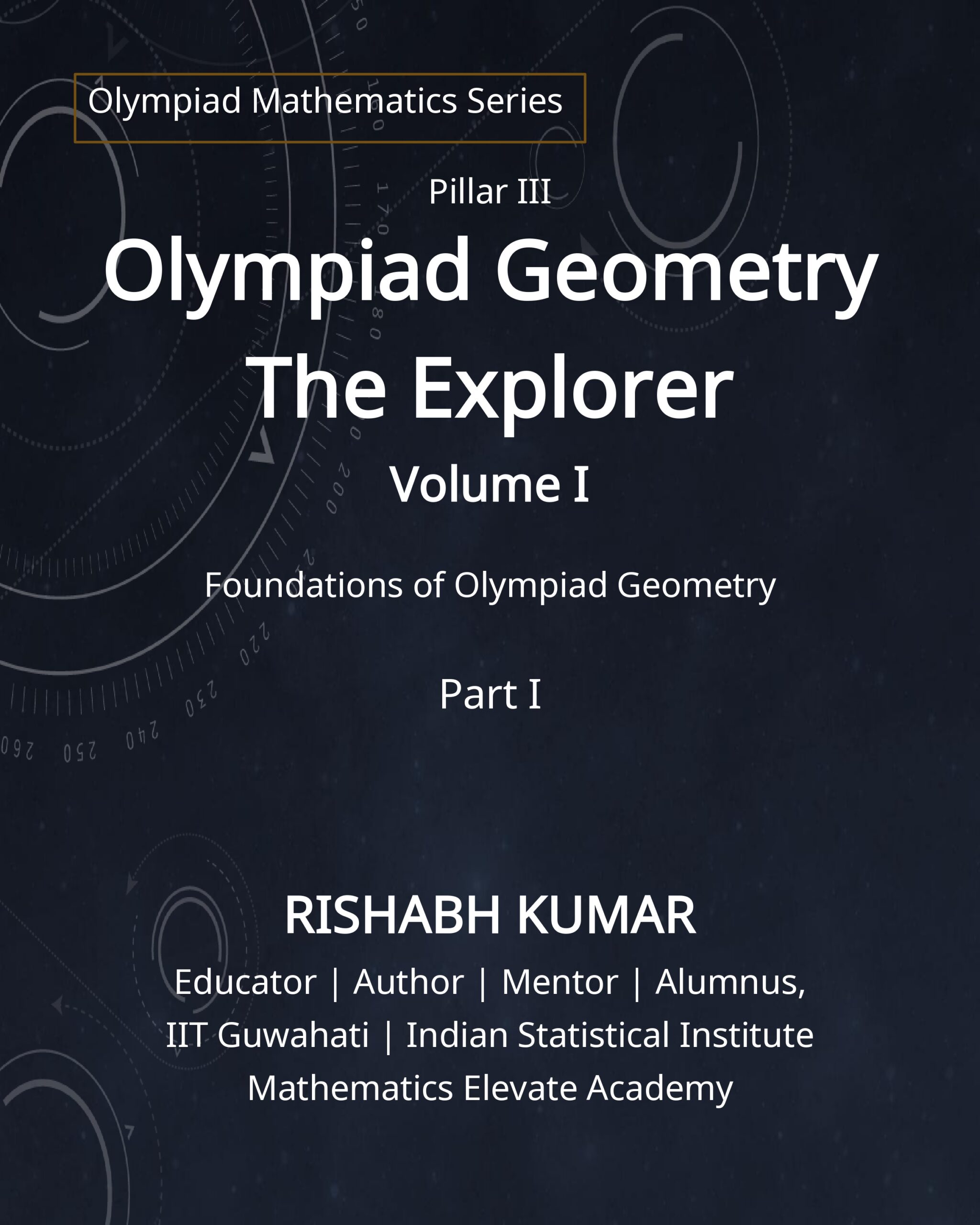
Mathematics Olympiad Series (The Explorer): Geometry
Olympiad Geometry – The Explorer : Volume I
Part I: Foundations of Olympiad Geometry
Other Countries: Check your local amazon marketplace.
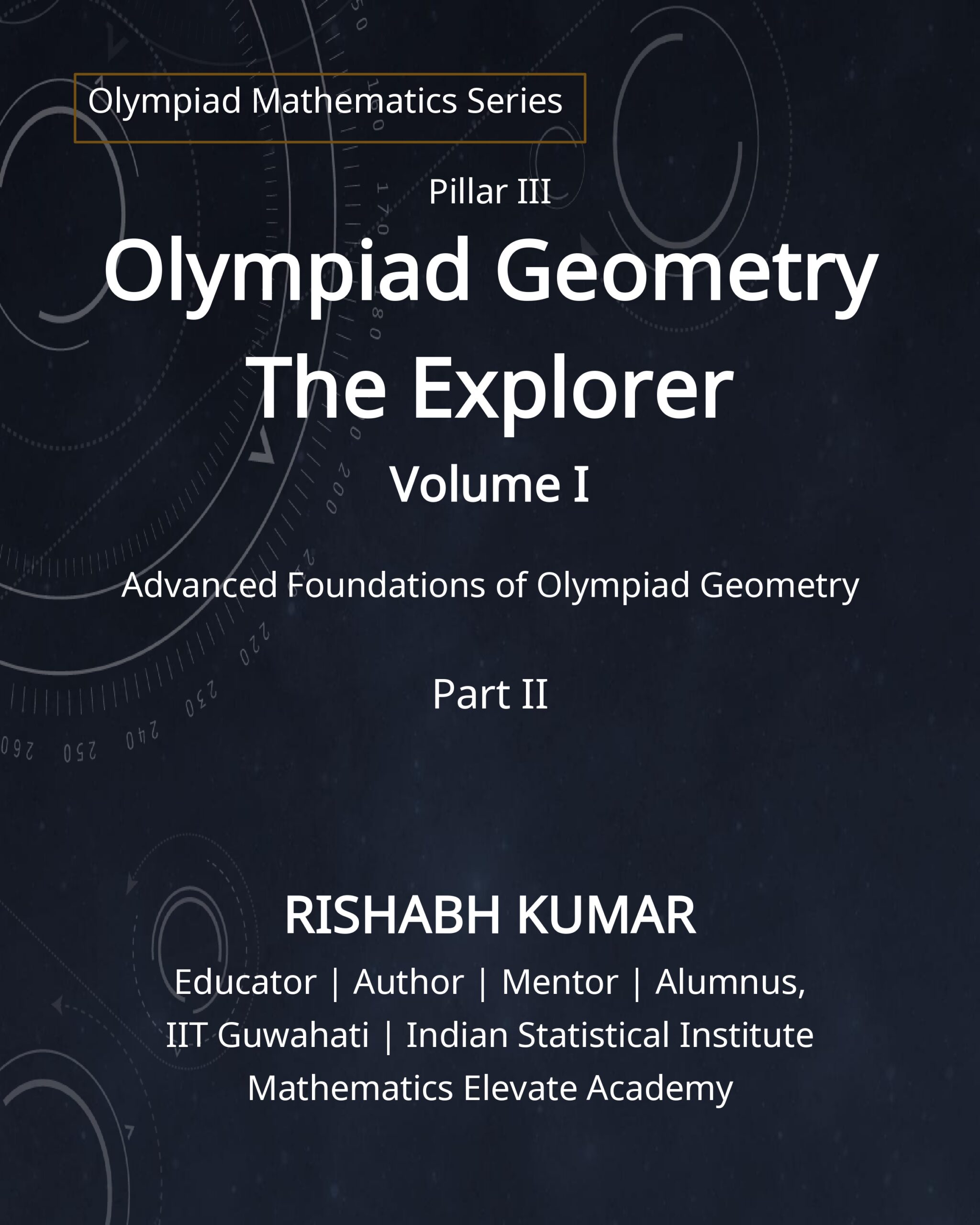
Mathematics Olympiad Series (The Explorer): Geometry
Olympiad Geometry – The Explorer : Volume I
Part II: Advanced Foundations of Olympiad Geometry
Other Countries: Check your local amazon marketplace.
Final Thoughts
Geometry is often called the mathematics of proof because it teaches students how to think logically, justify conclusions, and discover elegant relationships hidden within diagrams.
Rather than viewing theorems as isolated facts to memorize, think of them as powerful tools that work together to solve increasingly sophisticated problems. The more connections you build between these ideas, the more intuitive geometry becomes.
Whether you’re preparing for IB Mathematics, A-Level Mathematics, IGCSE, AP Calculus, the SAT, the ACT, or mathematics competitions such as the AMC, AIME, or national Olympiads, mastering these essential geometry theorems will give you a strong foundation for success.
At Mathematics Elevate Academy, we believe that true mathematical excellence comes from understanding concepts deeply, reasoning logically, and applying ideas creatively. Learn the theorems, understand their proofs, and practice using them—and geometry will transform from a collection of rules into one of the most rewarding areas of mathematics.
Master the theorems. Strengthen your reasoning. Elevate your mathematics.
