
 admin
admin A New Way to Learn AP Calculus
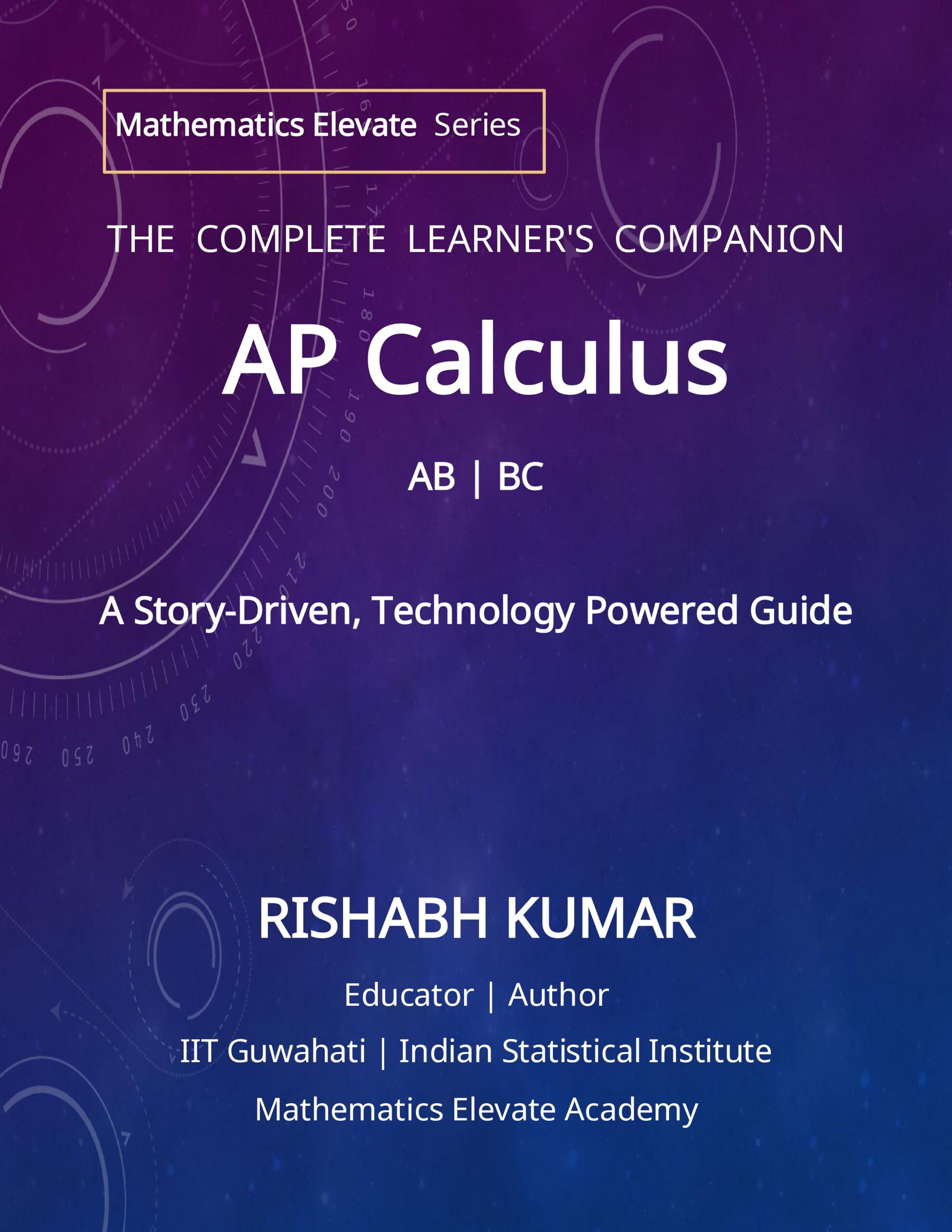
I am excited to announce the release of my new book:
AP Calculus AB & BC: The Complete Learner’s Companion
A Story-Driven, Code-Powered Guide with Practice Problems and Mock Tests
Written for students taking AP Calculus AB or AP Calculus BC, this book is designed around a simple philosophy:
Understand the idea before memorizing the formula.
Calculus is often taught as a collection of rules, formulas, and procedures. Students learn how to differentiate a function, evaluate an integral, apply a theorem, or solve a differential equation—but sometimes without developing a deeper understanding of why these ideas work.
This book takes a different approach.
It begins with the ideas behind calculus, develops intuition through stories and visual reasoning, connects concepts to real-world applications, and then builds the techniques students need to solve increasingly sophisticated problems.
Why I Wrote This Book
Over the years, while teaching mathematics to students from different countries and curricula, I have noticed a recurring pattern.
Many students are capable of performing calculations but struggle when a problem is presented in an unfamiliar form.
They may know the derivative rules but struggle to interpret a derivative.
They may know the Fundamental Theorem of Calculus but struggle to understand accumulation.
They may know how to find a critical point but struggle to explain what it means.
And they may know dozens of formulas but still ask:
“Which one am I supposed to use here?”
That is the gap this book is designed to address.
AP Calculus is not simply about performing calculations. It requires students to move comfortably between algebraic, graphical, numerical, verbal, and contextual representations.
The goal of this book is therefore not merely to help students finish the syllabus.
The goal is to help them think like calculus students.
What Makes This Book Different?
1. Calculus Through Stories and Intuition
Each major topic begins with the mathematical idea behind it.
Instead of immediately presenting a formula, the book asks questions such as:
- What does it mean for something to change at an instant?
- Why do we need limits?
- What does a derivative actually measure?
- Why does the derivative tell us about increasing and decreasing behavior?
- What does an integral represent?
- Why does accumulation lead naturally to the Fundamental Theorem of Calculus?
- What does an infinite series actually mean?
The purpose is to make the mathematics memorable by connecting formulas to ideas.
2. Complete AP Calculus AB & BC Coverage
The book is designed to cover the complete AP Calculus AB and BC curriculum.
It progresses through:
- Limits and Continuity
- Differentiation
- Applications of Differentiation
- Analytical Applications of Differentiation
- Integration and Accumulation of Change
- Differential Equations
- Applications of Integration
- Parametric Equations
- Polar Coordinates
- Vector-Valued Functions
- Infinite Sequences and Series
- Taylor and Maclaurin Series
Students studying AP Calculus AB can use the AB material throughout the book, while BC-exclusive material is clearly identified.
BC ONLY
Special sections are explicitly marked BC ONLY, allowing AB students to identify the additional BC material immediately without having to navigate a separate textbook.
Learn the Mathematics. Then Use It.
A major feature of the book is the integration of technology into the learning process.
Calculus is fundamentally visual.
A graph can reveal behavior that an algebraic expression hides.
A numerical table can make the meaning of a limit immediately visible.
A computer algebra system can verify a derivative or integral.
A graphing calculator can help students explore a function before attempting an analytical solution.
For this reason, the book incorporates hands-on exploration using:
Desmos
Students can visualize functions, limits, derivatives, integrals, intersections, areas, and other concepts dynamically.
Python with SymPy
Students can use symbolic computation to differentiate, integrate, simplify, expand, factor, and investigate mathematical expressions.
Graphing Calculators
Calculator-based techniques are integrated into appropriate sections so students understand not only what buttons to press, but also why the calculation works and how to interpret the result.
Technology is therefore treated as a mathematical laboratory, not merely as a calculator.
Built for AP-Style Problem Solving
Understanding calculus is only part of the journey.
Students also need to learn how to communicate mathematical reasoning and handle unfamiliar AP-style questions.
Throughout the book, students encounter:
- Carefully worked examples
- Try It Yourself problems
- AP-style multiple-choice questions
- Free-response questions
- Graphical and numerical problems
- Real-world applications
- Common-mistake alerts
- Decision guides
- Concept maps
- Formula and theorem sheets
- Unit checklists
- Mixed practice
The aim is to move students through a progression:
Understand → Practice → Connect → Apply → Solve → Explain
Learn to Recognize the Problem
One of the most important skills in calculus is knowing what kind of problem you are looking at.
Should you use the definition of the derivative?
The Chain Rule?
Implicit differentiation?
The Mean Value Theorem?
A sign chart?
The Fundamental Theorem of Calculus?
Separation of variables?
A Taylor polynomial?
The Ratio Test?
A calculator?
Or perhaps no calculator at all?
The book therefore includes decision guides and structured problem-solving frameworks designed to help students recognize the mathematical structure of a problem before jumping into calculations.
This is particularly valuable for AP students because unfamiliar problem presentations can often be more challenging than the underlying mathematics.
From First Principles to Advanced Calculus
The book begins with one of the central philosophical questions of calculus:
Can something change at a single instant?
From average rate of change, we arrive at instantaneous rate of change.
From instantaneous rate of change, we arrive at the derivative.
From derivatives, we develop applications.
From accumulation, we arrive at the definite integral.
From derivatives and integrals, we discover their fundamental connection.
And eventually, AP Calculus BC takes us toward:
- Parametric motion
- Polar geometry
- Vector-valued functions
- Infinite series
- Taylor polynomials
- Taylor and Maclaurin series
- Power series
- Error bounds
- Radius and interval of convergence
The book is therefore designed not as a disconnected collection of chapters, but as a mathematical journey.
Practice, Review, and Mock Exams
The book goes beyond instructional content.
After completing the core material, students have access to extensive AP-style practice organized by unit.
The practice section includes:
Unit-by-Unit Practice
Students can test their understanding immediately after completing each AP Calculus unit.
Multiple-Choice Practice
Designed to develop speed, conceptual recognition, and accuracy.
Free-Response Practice
Designed to develop mathematical communication, justification, interpretation, and multi-step problem solving.
Full-Length Practice Exams
Students can bring everything together under realistic exam-style conditions.
Detailed Solutions
Solutions are designed not merely to provide answers, but to demonstrate the reasoning behind them.
Who Is This Book For?
This book is designed for a wide range of AP Calculus students.
AP Calculus AB Students
Use the book as a complete learning and review companion while skipping clearly marked BC-only material.
AP Calculus BC Students
Use the entire book for a complete AB + BC learning pathway.
Independent Learners
Students studying outside a traditional classroom can use the book as a structured self-study resource.
Students Preparing for a 5
Students who already understand the fundamentals can use the advanced applications, practice problems, decision guides, and mock examinations to strengthen their performance.
Students Who Struggle With Calculus
The story-driven and conceptual approach is particularly useful for students who find traditional formula-first textbooks difficult to follow.
Teachers and Tutors
The structured chapters, examples, exercises, technology explorations, and review resources can also serve as supplementary instructional material.
Beyond the AP Exam
Although the book is designed around AP Calculus AB and BC, the purpose of learning calculus extends far beyond one examination.
Calculus forms a foundation for fields such as:
- Mathematics
- Physics
- Engineering
- Economics
- Finance
- Statistics
- Data Science
- Machine Learning
- Artificial Intelligence
- Quantitative Finance
A strong understanding of calculus can therefore become an important part of a student’s preparation for university-level STEM and quantitative studies.
At Mathematics Elevate Academy, AP Calculus is approached not simply as an examination subject, but as an important mathematical foundation for advanced study.
A Resource for the Entire AP Calculus Journey
One of the goals of this book was to create something students could return to repeatedly.
You can use it when:
Starting the course
→ Build conceptual foundations.
During the school year
→ Learn and practice each unit systematically.
Before a unit test
→ Review the concept maps, formulas, examples, and exercises.
Before the AP exam
→ Work through mixed practice and free-response questions.
During final revision
→ Use the formula sheets, decision guides, checklists, and mock examinations.
The book is intended to stay useful throughout the entire AP Calculus journey.
The Philosophy Behind the Book
At the heart of this book is a simple belief:
Mathematics becomes easier when you understand what the mathematics is trying to say.
A derivative is not merely a rule.
An integral is not merely an antiderivative.
A limit is not merely a calculation.
A Taylor polynomial is not merely a formula.
Each represents an idea.
And once the idea becomes clear, the formulas become much easier to remember—and much harder to misuse.
Now Available on Amazon
AP Calculus AB & BC: The Complete Learner’s Companion is now available on Amazon.
🇺🇸 Amazon US
📚 AP Calculus Resources
For additional AP Calculus resources, course information, and learning materials, visit:
Mathematics Elevate Academy — AP Calculus
A Message to Students
If you are currently studying AP Calculus, remember that you do not need to understand everything immediately.
Calculus is cumulative.
A difficult concept today may become obvious after you understand the next one.
Ask questions.
Draw graphs.
Experiment.
Make mistakes.
Solve problems without looking at the solution.
Then solve them again.
Most importantly, do not reduce calculus to memorizing formulas.
Understand what the formula means.
Understand why it works.
Understand when to use it.
And eventually, you will find that calculus becomes much more than an AP subject.
It becomes a way of seeing mathematics.
Welcome to the Journey
AP Calculus AB & BC: The Complete Learner’s Companion
by Rishabh Kumar
Educator • Author
Alumnus, IIT Guwahati and Indian Statistical Institute
If you are ready to move beyond memorization and develop a deeper understanding of calculus, I hope this book becomes a valuable companion throughout your AP Calculus journey.
Understand the idea. See the picture. Master the mathematics. Then learn to use it.
