
 admin
admin The final stage of TMUA preparation is not about learning everything again. It is about practising under pressure, identifying weaknesses, improving your decision-making and learning how to perform consistently across both papers.
To support students preparing for the Test of Mathematics for University Admission (TMUA), Mathematics Elevate Academy is pleased to announce the upcoming release of:
TMUA Mock Tests: 5 Complete Practice Papers
Paper 1 & Paper 2 | 200 Original Questions | Fully Worked Solutions
The book will be available shortly and is designed specifically for students who want a focused collection of complete TMUA-style practice papers rather than another general mathematics textbook.
With the examination approaching, this book provides an opportunity to move from learning and revision to serious examination practice.
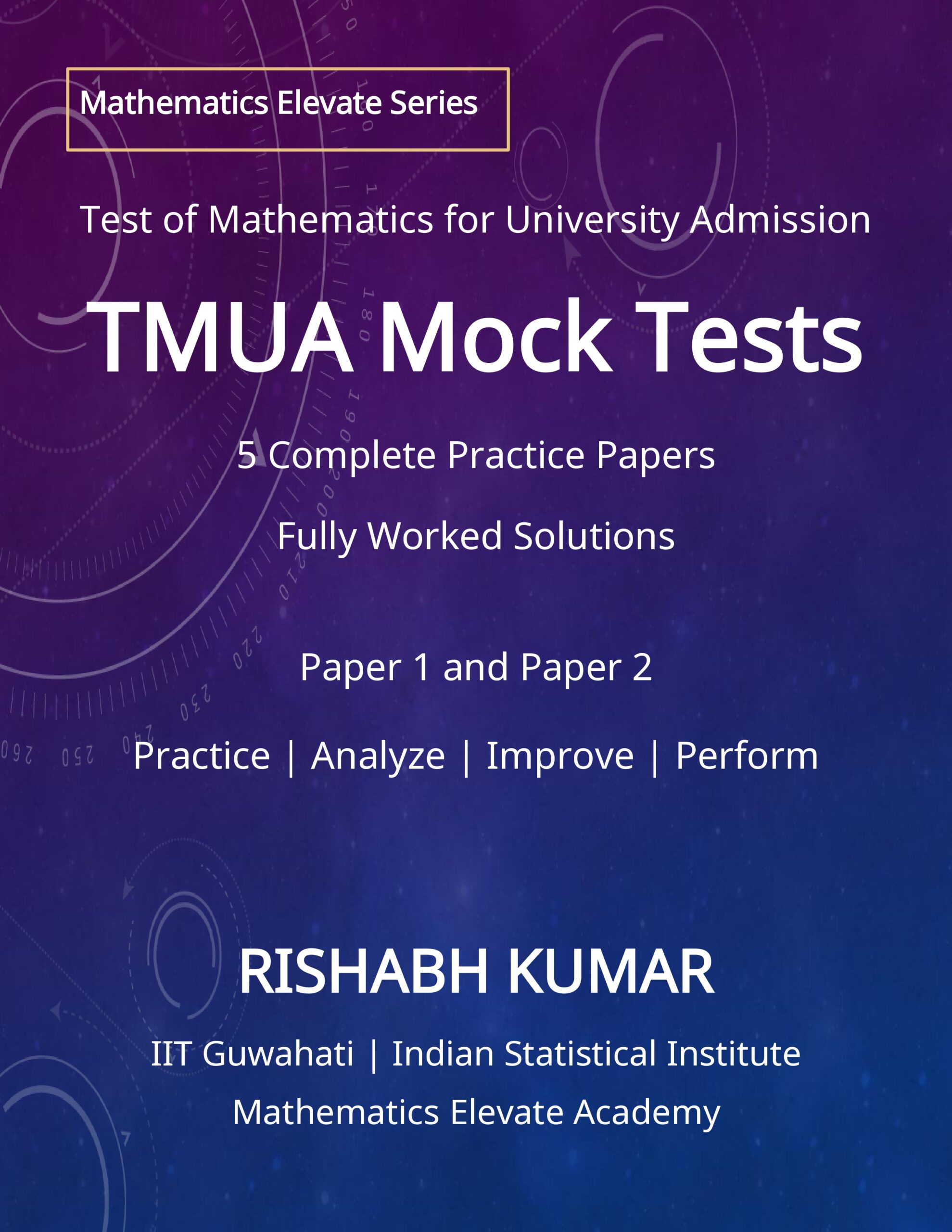
5 Complete Mock Tests. 10 Papers. 200 Questions.
The book contains:
- 5 complete mock tests
- Paper 1 and Paper 2 in every mock test
- 10 full practice papers
- 20 questions per paper
- 200 original questions in total
- 75 minutes allocated to each paper
- Fully worked solutions
- Structured opportunities for performance analysis and error review
The aim is simple:
Practise. Analyse. Improve. Perform.
Each mock test can be attempted under timed examination conditions, allowing students to develop not only mathematical ability but also the habits required to perform effectively under pressure.
Why Mock Tests Matter in TMUA Preparation
Knowing the mathematics is only one part of preparing for a demanding university admissions test.
A student may understand algebra, functions, calculus, probability or coordinate geometry and still struggle in an examination because of:
- Poor time management
- Spending too long on one difficult question
- Misreading a condition
- Choosing an inefficient method
- Making avoidable algebraic errors
- Failing to recognise a familiar mathematical structure
- Losing time through excessive calculation
- Changing a correct answer unnecessarily
- Not knowing when to move on
These issues are difficult to identify by simply studying notes or watching lessons.
They become much more visible when you take a complete timed paper.
That is why mock tests should become an important part of the final stage of TMUA preparation.
What Makes This Book Different?
There are many collections of mathematics questions available to students.
However, a complete mock test serves a different purpose.
A mock test asks you to bring together everything you have learned and make decisions under realistic time constraints.
This book has therefore been designed around the complete practice experience.
Each paper gives you an opportunity to practise:
Mathematical Thinking
TMUA preparation requires more than remembering formulas. You need to identify structure, make connections and determine what information in a problem is actually important.
Problem Solving
Many admissions-test questions are unfamiliar at first sight. The challenge is often to find the right representation, observation or mathematical idea.
Accuracy
A strong mathematical solution is not enough if the final answer is incorrect because of an avoidable error.
Repeated timed practice helps you identify recurring mistakes.
Time Management
You need to balance difficult questions against the limited time available.
A good strategy is not necessarily to solve every question in order.
Examination Strategy
You need to develop a personal approach to:
- Which questions to attempt first
- When to continue working
- When to move on
- When to return to a difficult question
- How much checking time to reserve
- How to minimise careless errors
These skills develop through practice.
5 Mock Tests for Structured Preparation
The five mock tests can be used progressively rather than simply taken one after another.
Mock Test 1: Establish Your Baseline
Begin with a realistic timed attempt.
Do not worry too much about your score at this stage.
Instead, use the first mock to understand your current performance.
Ask:
- How many questions did I attempt?
- How many did I answer correctly?
- Where did I lose time?
- Which topics caused difficulty?
- Which mistakes were conceptual?
- Which mistakes were simply careless?
This becomes your baseline.
Mock Test 2: Identify Your Weaknesses
After analysing the first mock, work on the weaknesses you identified.
Then take the second mock under timed conditions.
Your objective is not simply to obtain a higher score.
You should also ask whether your process has improved.
Are you reading questions more carefully?
Are you recognising patterns more quickly?
Are you avoiding unnecessary calculations?
Are you making fewer avoidable mistakes?
Mock Test 3: Improve Efficiency
By the third mock, you should begin paying particular attention to efficiency.
A question that takes several minutes using one method may sometimes be solved much more efficiently using another observation or representation.
After the test, compare your approach with the worked solutions.
Ask:
“Was my method correct, but unnecessarily long?”
This is an important question for admissions-test preparation.
Mock Test 4: Refine Your Examination Strategy
The fourth mock can be used to simulate a serious examination attempt.
Practise:
- Maintaining concentration
- Managing difficult questions
- Moving on when necessary
- Returning to marked questions
- Controlling your pace
- Protecting your accuracy
At this stage, your preparation should increasingly resemble the actual examination experience.
Mock Test 5: Final Simulation
Use the final mock as a complete examination simulation.
Create the closest possible examination environment.
Put away your phone.
Remove distractions.
Use the appropriate time limit.
Do not pause the paper.
Do not check solutions during the attempt.
Treat the complete session as if it were the real examination.
The objective is to understand how you perform when the result actually matters.
How to Use the Fully Worked Solutions
The solutions are not intended merely to tell you which option is correct.
They should be used as a tool for post-test analysis.
After completing a paper, classify each question.
Category 1: Correct and Confident
You understood the problem and solved it efficiently.
Move on.
Category 2: Correct but Uncertain
You obtained the correct answer but were not confident about your method.
Study the solution and determine whether there was a more reliable approach.
Category 3: Incorrect but Close
You understood the central idea but made an algebraic, arithmetic or logical error.
Record the mistake.
Category 4: Incorrect Because of Method
You selected an approach that did not lead efficiently to the answer.
Study the worked solution carefully.
Category 5: Could Not Solve
This is often the most valuable category.
Do not simply read the solution and move on.
Try the problem again after studying the key idea.
Then ask yourself whether you could recognise the same structure if a similar problem appeared later.
Build an Error Log
One of the most effective ways to use mock tests is to maintain an error log.
For every significant mistake, record:
Question number
Topic
What went wrong?
Why did it happen?
Correct approach
What will I do differently next time?
For example:
I spent too long trying to solve the problem algebraically before recognising the underlying structure.
That is more useful than simply writing:
Wrong answer.
Your objective is to prevent the same type of mistake from appearing repeatedly.
Do Not Measure Progress Only by Score
A higher score is obviously encouraging.
However, score alone does not tell the complete story.
Suppose your score remains similar between two mocks, but:
- You attempted more questions.
- You made fewer careless mistakes.
- You managed your time better.
- You solved difficult questions more efficiently.
- You identified weaknesses more accurately.
That is genuine progress.
Similarly, a higher score does not always mean that your preparation has improved if the improvement resulted from unusually familiar questions or favourable circumstances.
Look at the complete performance picture.
The Final Stage of TMUA Preparation
When the examination is close, students often make the mistake of trying to learn an enormous amount of new material.
This can create unnecessary stress.
The final stage should instead focus heavily on:
Consolidation
Timed practice
Problem solving
Error analysis
Exam strategy
Accuracy
Confidence
If you already know the mathematics, your remaining preparation time should increasingly be used to improve how effectively you apply that mathematics.
This is where full-length mock tests become particularly valuable.
A Suggested Final Practice Routine
If you have limited time remaining before the examination, consider using a cycle such as:
Step 1 — Take a complete paper
Attempt the paper under strict timed conditions.
Step 2 — Mark your answers
Record your score and identify questions that caused difficulty.
Step 3 — Analyse every mistake
Do not limit your review to incorrect answers.
Also review questions where:
- You guessed
- You were uncertain
- You spent too much time
- Your method was inefficient
Step 4 — Review the underlying mathematics
Return to the relevant concept only when necessary.
Step 5 — Reattempt difficult questions
Try solving them again without immediately looking at the solution.
Step 6 — Record your lessons
Update your personal error log.
Step 7 — Take the next paper
Apply what you learned.
This creates a continuous cycle:
Attempt → Analyse → Learn → Reattempt → Improve
200 Original Questions for Serious Practice
The book contains 200 original questions, distributed across five complete mock tests.
This gives students enough material to experience a wide range of mathematical structures and problem-solving situations.
The objective is not simply to complete 200 questions.
The objective is to become better at solving the next unfamiliar question.
That distinction matters.
Admissions tests reward students who can think mathematically when a problem does not immediately resemble something they have seen before.
Who Is This Book For?
TMUA Mock Tests: 5 Complete Practice Papers is suitable for students who are already familiar with the mathematical content required for the examination and want substantial practice.
It is particularly useful for students who want to:
- Practise complete TMUA-style papers
- Develop examination stamina
- Improve time management
- Strengthen mathematical reasoning
- Identify recurring weaknesses
- Improve accuracy
- Practise under realistic conditions
- Analyse fully worked solutions
- Build confidence before the examination
It can be used alongside classroom teaching, private tuition, online courses or independent study.
Not Just Another Question Bank
A question bank allows you to choose individual questions.
A mock test asks you to make decisions.
That difference is important.
In a real examination, you do not get to choose the questions you are comfortable with. You receive the paper and must decide how to navigate it.
A complete mock test therefore trains an additional skill:
decision-making under pressure.
This is one of the reasons full-length practice should become increasingly important as the examination approaches.
From Mathematics Elevate Academy
This book is published by Mathematics Elevate Academy, an educational platform dedicated to advanced mathematics, mathematical problem solving, examination preparation and competitive mathematics.
Mathematics Elevate Academy provides learning resources for students preparing for a range of international curricula, university admissions tests and mathematical competitions.
Students can also explore:
- TMUA preparation resources
- Mathematics blogs and articles
- Free downloadable resources
- TMUA learning materials
- Silent self-learning video lessons
- Mathematical visualisation resources
- Math By Rishabh Series
- Mathematics Elevate Series
- Other advanced mathematics resources
Visit the Mathematics Elevate Academy TMUA page for the latest resources and updates.
About the Author
Rishabh Kumar is an educator, author and mathematics mentor with over 8 years of teaching experience.
He is the founder of Mathematics Elevate Academy and the author of the Math By Rishabh Series and Mathematics Elevate Series.
He holds a Master’s degree in Applied Statistics from the Indian Statistical Institute, Kolkata, and has an academic background spanning mathematics, statistics and financial engineering.
His work focuses on helping students develop mathematical understanding, problem-solving ability and competitive examination skills.
The Book at a Glance
Title: TMUA Mock Tests: 5 Complete Practice Papers
Subtitle: Paper 1 & Paper 2 | 200 Original Questions | Fully Worked Solutions
Number of Mock Tests: 5
Papers per Mock: 2
Total Papers: 10
Questions per Paper: 20
Total Original Questions: 200
Time per Paper: 75 minutes
Solutions: Fully worked solutions
Format: Paperback
Available Shortly
The book is currently being prepared for publication and will be available shortly on Amazon.
If your TMUA examination is approaching, this is the time to move beyond passive revision and begin testing your preparation under realistic conditions.
Take a paper.
Work under time pressure.
Analyse your mistakes.
Learn from the solutions.
Take the next paper.
Then repeat.
Practice. Analyse. Improve. Perform.
Explore More TMUA Resources
Mathematics Elevate Academy is continuously developing new TMUA resources, including learning materials, articles, videos and downloadable resources.
Visit the Mathematics Elevate Academy TMUA webpage for the latest updates and resources.
Mathematics Elevate Academy
Learn. Understand. Practise. Compete.
