
 admin
admin Mathematics is often introduced as a collection of formulas and procedures. Students are taught to manipulate symbols, solve equations, and apply algorithms. While these skills are important, they represent only one dimension of mathematical thinking.
Behind every equation lies a shape.
Behind every formula lies a pattern.
And behind every pattern lies a deeper mathematical structure that can often be seen most clearly through graphs.
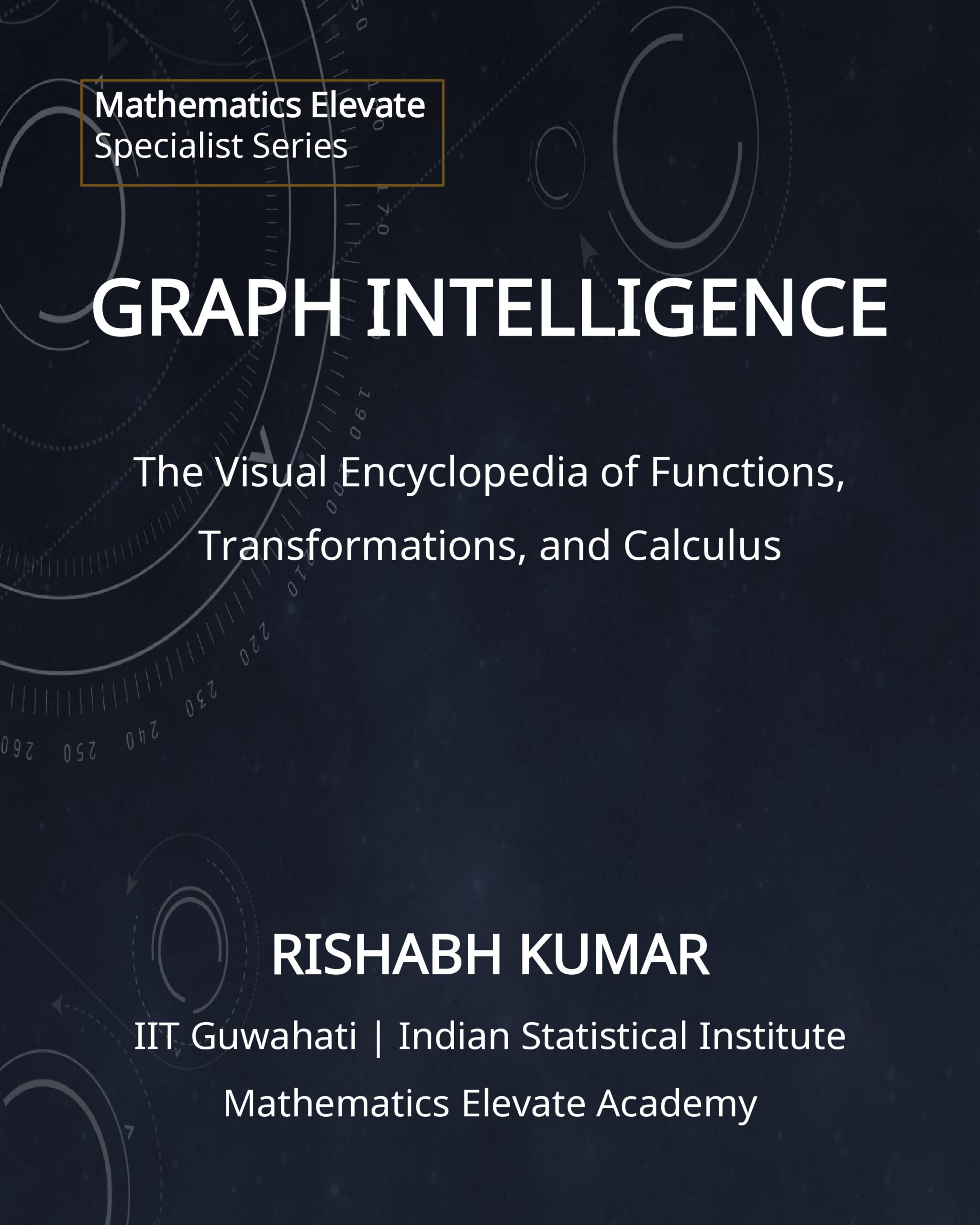
Graph Intelligence: The Visual Encyclopedia of Functions, Graphs, Transformations, and Calculus was written to help students develop exactly this kind of visual mathematical intuition.
This book explores the idea that mathematics becomes far more intuitive when we learn to see it.
Why Graphs Matter in Mathematics
Graphs transform abstract equations into visual objects. A function is no longer just a symbolic rule—it becomes a curve, a surface, a structure that can be analyzed geometrically.
Through graphs we can immediately observe:
- growth and decay
- oscillations and periodic behavior
- symmetry and transformations
- asymptotic behavior
- intersections and roots
- relationships between variables
Many concepts that appear complicated algebraically become surprisingly simple once their graphs are understood.
For example:
- exponential growth models population and finance
- logarithmic curves describe scaling behavior
- trigonometric graphs describe oscillatory motion
- polynomial curves capture turning points and inflection behavior
Graphical reasoning is therefore not just a visualization tool—it is a fundamental mathematical language.
What This Book Covers
Graph Intelligence is designed as a comprehensive visual reference for the most important families of mathematical graphs.
The book includes structured explanations and visual representations of major function types, including:
- Polynomial functions
- Power and root functions
- Rational and reciprocal functions
- Exponential and logarithmic functions
- Trigonometric graphs
- Special mathematical functions
- Oscillatory and harmonic curves
- Gaussian and logistic models
- Parametric and polar graphs
Each section emphasizes both the algebraic structure and the visual behavior of functions.
The Atlas of Mathematical Graphs
One of the central features of the book is the Atlas of Mathematical Graphs.
This section functions as a visual encyclopedia of mathematical curves. Each graph entry typically includes:
- the parent function
- the standard equation
- graphical transformations
- structural features
- recognition tips
- real-world interpretations
The goal is to help readers recognize common mathematical shapes almost instantly.
Over time, these graphs become part of a student’s visual mathematical vocabulary.
From Equations to Visual Thinking
The concept behind this book is what we call Graph Intelligence.
Graph intelligence is the ability to look at an equation and immediately form a mental picture of its behavior.
For example, an experienced mathematician can quickly recognize:
- the shape of a quadratic curve
- the asymptotes of a rational function
- the periodic behavior of a trigonometric function
- the growth pattern of an exponential model
Developing this skill makes problem solving faster, more intuitive, and often far more enjoyable.
Applications Across Mathematics and Science
Graphical thinking is not limited to pure mathematics.
Graphs play a crucial role in many fields, including:
- physics (motion and wave phenomena)
- biology (population growth models)
- chemistry (reaction rates)
- economics (supply and demand models)
- finance (compound interest and growth)
- data science and machine learning (loss functions and optimization)
Understanding graph structures therefore builds intuition that extends well beyond the classroom.
Who This Book Is For
Graph Intelligence is designed for students studying advanced school mathematics as well as early university mathematics.
It is particularly useful for students preparing for demanding mathematical examinations such as:
- STEP (Sixth Term Examination Paper)
- MAT (Oxford Mathematics Admissions Test)
- TMUA (Test of Mathematics for University Admission)
- Mathematical Olympiads
- IB Mathematics AA HL
- A-Level Mathematics and Further Mathematics
- Advanced calculus preparation
The book focuses heavily on recognition, structure, and conceptual understanding, which are essential for success in these programs.
A Free PDF Edition
In order to make high-quality mathematics resources widely accessible, a free PDF edition of this book is available.
Students and educators around the world can download the digital version and explore the material freely for personal and educational use.
The printed paperback and hardcover editions are also available through Amazon marketplaces in many countries.
Part of the Mathematics Elevate Library
Graph Intelligence is part of the growing Mathematics Elevate Library, a global collection of mathematics books designed to support learners at different stages of their mathematical journey.
The library currently includes several major series:
- Mathematics Elevate Foundations Series (Grades 5–10)
- Math by Rishabh Series (deep topic mastery)
- Mathematics Elevate STEP Programme Series
- Mathematics Elevate IB DP AA HL Series
- Mathematics Elevate Olympiad Series
- Mathematics Elevate AP Series
- Mathematics Elevate A-Level and Further Mathematics Series
- Specialized preparation for MAT, TMUA, and other university entrance examinations
Together these books form a structured learning ecosystem for serious mathematics students.
Learning Mathematics Visually
Mathematics is often perceived as abstract, but at its core it is a language of patterns.
Graphs allow us to see those patterns.
When students develop the ability to recognize mathematical shapes and structures visually, equations stop being mysterious symbols and start becoming meaningful objects.
That transformation—from symbolic manipulation to visual understanding—is the essence of graph intelligence.
And it is the central idea behind this book.
Explore the Book
To explore the free PDF edition and learn more about the Mathematics Elevate Library, visit:
