
 admin
Mathematics is much more than a collection of formulas, calculations, and procedures. It is a structured way of understanding relationships, identifying patterns, expressing ideas precisely, and solving problems through logical reasoning.
A strong mathematical foundation does not begin with memorising complicated formulas. It begins with understanding what mathematics represents, learning how mathematical statements communicate ideas, recognising the conventions used in mathematical language, and developing the habits required to approach unfamiliar problems.
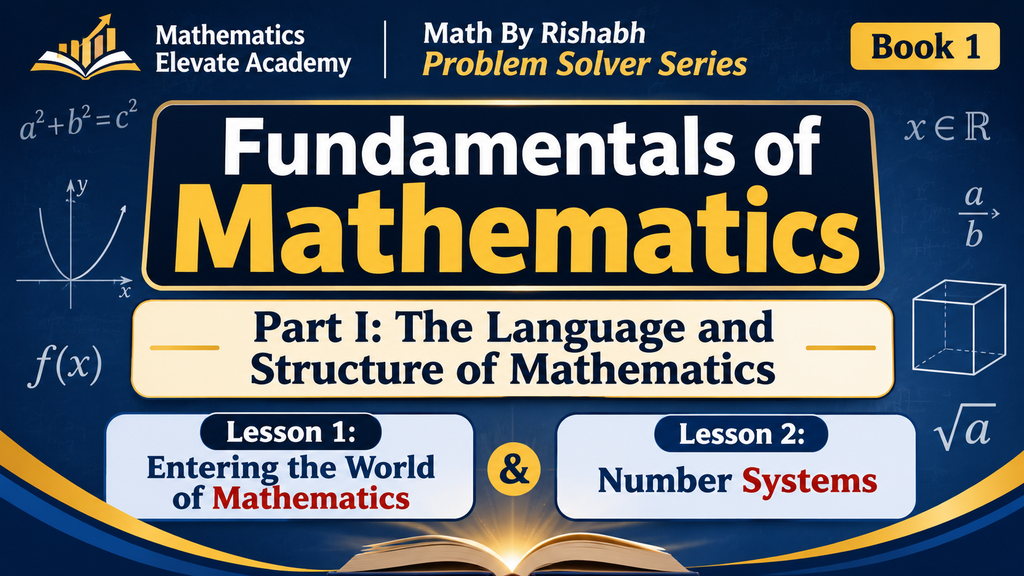
In the first video of the Math By Rishabh Problem Solver Series – Book 1: Fundamentals of Mathematics, we begin this journey by exploring two essential lessons:
- Entering the World of Mathematics
- Number Systems
These lessons form the foundation of Part I: The Language and Structure of Mathematics. They introduce students to the fundamental language of mathematics and establish an understanding of the different types of numbers used throughout the subject.
Watch the complete lesson below.
Watch: Fundamentals of Mathematics | Part 1 | Math By Rishabh Problem Solver Series (Book 1)
1. Why Should We Study the Fundamentals of Mathematics?
Many students begin studying mathematics by learning arithmetic operations, algebraic identities, equations, and formulas. Although these skills are important, mathematical proficiency requires something deeper: the ability to understand the structure behind mathematical ideas.
Consider the following questions:
- What does it mean for a mathematical statement to be true?
- Why do mathematicians use precise definitions and conventions?
- How are natural numbers, integers, rational numbers, and real numbers related?
- Why can some numbers be expressed as fractions while others cannot?
- How should we approach a mathematical problem when the solution method is not immediately obvious?
These questions illustrate the importance of mathematical foundations.
When students understand the language and structure of mathematics, they become better equipped to interpret problems, recognise relationships, construct arguments, and develop solutions independently.
The purpose of this introductory unit is to establish these habits before moving towards more advanced mathematical topics.
2. Lesson 1: Entering the World of Mathematics
The first lesson introduces mathematics as a subject built upon logical structures, precise communication, patterns, and reasoning.
It is designed to help students move beyond the idea that mathematics is simply about obtaining numerical answers.
2.1 What Is Mathematics?
Mathematics is the study of patterns, structures, quantities, relationships, and logical systems.
It provides a framework for describing and analysing the world around us. From the movement of planets and the behaviour of financial markets to computer algorithms and engineering systems, mathematical ideas are used to understand complex phenomena.
However, mathematics is not limited to its applications.
It is also an abstract discipline in which we define objects, establish relationships, formulate statements, and investigate what follows logically from given assumptions.
For example:
- Arithmetic studies numerical operations and relationships.
- Algebra investigates mathematical structures using symbols and variables.
- Geometry explores shapes, spatial relationships, and properties of figures.
- Number theory examines the properties and relationships of integers.
- Calculus studies change, accumulation, and limiting behaviour.
Although these branches study different mathematical objects, they share a common foundation: precise definitions, logical reasoning, and systematic problem-solving.
Understanding this perspective helps students appreciate mathematics as a connected discipline rather than a collection of unrelated chapters.
2.2 Reading Mathematical Statements
Mathematics has its own language.
Symbols, expressions, equations, inequalities, and logical statements communicate mathematical information in a concise and precise manner.
Consider the following examples:
Example 1: An equation
x + 5 = 12
This statement tells us that the sum of a number and five is equal to twelve.
Example 2: An inequality
x > 3
This expresses that x is greater than three.
Example 3: A mathematical identity
(a + b)² = a² + 2ab + b²
This identity describes a relationship that holds for all real values of a and b.
These statements are not interchangeable. An equation asserts equality, an inequality expresses an order relationship, and an identity represents a relationship that remains valid throughout its specified domain.
Students must learn to interpret mathematical statements carefully before attempting to manipulate them.
A common source of mistakes in mathematics is not necessarily a lack of computational ability but a misunderstanding of what the question or mathematical statement actually means.
2.3 Mathematical Conventions
Mathematical communication relies on conventions that allow ideas to be expressed consistently.
For example:
- Brackets indicate grouping and determine the order of operations.
- Exponents represent repeated multiplication or more general power operations.
- Mathematical symbols have established meanings.
- Variables represent quantities whose values may be unknown or may vary.
- Equality represents a relationship between two expressions, not an instruction to calculate.
Consider:
2 + 3 × 4
According to the standard order of operations, multiplication is performed before addition.
Therefore:
2 + 3 × 4 = 2 + 12 = 14
However:
(2 + 3) × 4 = 5 × 4 = 20
The placement of brackets changes the interpretation of the expression and consequently changes its value.
Understanding conventions is essential because mathematical reasoning depends on interpreting expressions correctly.
2.4 Developing Mathematical Habits
Becoming proficient in mathematics requires developing habits that support independent thinking.
Some particularly important habits include:
1. Understand before calculating
Read the problem carefully and identify what is given and what needs to be determined.
2. Ask why
Do not simply memorise a procedure. Understand why a particular method works and under which conditions it is valid.
3. Look for patterns
Mathematical problems often contain relationships that become visible when we examine examples, compare quantities, or organise information.
4. Work systematically
Present calculations and arguments in a logical sequence. Avoid skipping important reasoning steps.
5. Verify your results
Check whether the answer satisfies the original conditions of the problem.
6. Learn from mistakes
An incorrect solution can reveal a misunderstanding, an invalid assumption, or an overlooked condition.
These habits become increasingly important as students progress towards algebra, geometry, calculus, probability, and advanced problem-solving.
2.5 Problem-Solving Warm-Up
Problem-solving is an essential part of learning mathematics.
Rather than immediately searching for a formula, students should first understand the structure of a problem.
A systematic approach generally involves:
- Understanding the problem.
- Identifying the available information.
- Determining the relationship between the given quantities.
- Developing a possible strategy.
- Carrying out the solution carefully.
- Checking and interpreting the result.
This approach encourages students to think independently and develop mathematical intuition.
The objective is not merely to arrive at an answer but to understand why the solution works.
2.6 A First Problem-Solving Challenge
The lesson concludes with an introductory problem-solving challenge that encourages students to apply their developing mathematical understanding.
Such challenges are important because mathematical learning becomes meaningful when concepts are applied rather than simply read or memorised.
Students should attempt problems independently, explore different approaches where possible, and examine the reasoning behind each solution.
3. Lesson 2: Number Systems
Numbers are the fundamental objects used throughout mathematics.
However, not all numbers have the same properties. Some are used for counting, some represent negative quantities, some can be expressed as fractions, and others cannot be represented as ratios of integers.
To understand these differences, mathematics classifies numbers into different number systems.
The second lesson introduces the principal number systems and explains how they are related.
3.1 Natural Numbers
Natural numbers are commonly used for counting.
They are generally represented by:
N = {1, 2, 3, 4, 5, …}
For example, if there are five books on a table, the number five represents the quantity of books.
Natural numbers form the starting point for elementary counting and arithmetic.
An important convention: Some mathematical texts include zero in the natural numbers, while others begin with one. Students should always check the convention being used in a particular textbook or examination.
3.2 Whole Numbers and Zero
Whole numbers extend the natural numbers by including zero.
They are represented by:
W = {0, 1, 2, 3, 4, …}
Zero represents the absence of a quantity in many counting contexts.
Its inclusion allows us to describe situations in which no objects are present and provides an essential foundation for arithmetic and algebra.
For example:
- Having three books is represented by 3.
- Having no books is represented by 0.
Zero also plays a special role in mathematical operations. It is the additive identity because adding zero to a number does not change that number.
3.3 Integers
Integers extend whole numbers by including negative numbers.
The set of integers is:
Z = {…, -3, -2, -1, 0, 1, 2, 3, …}
Integers are useful when quantities can occur on either side of zero.
For example:
- A temperature of 5 degrees above zero can be represented by +5.
- A temperature of 5 degrees below zero can be represented by -5.
- A change of zero represents no increase or decrease.
Integers are particularly important when studying negative quantities, subtraction, number lines, algebraic equations, and divisibility.
3.4 Rational Numbers
A rational number is any number that can be expressed as a fraction of two integers, provided that the denominator is non-zero.
In general:
r = p/q
where p and q are integers and q is not equal to zero.
The set of rational numbers is commonly represented by Q.
Examples include:
- 1/2
- -3/4
- 5
- 0
- 0.25
- 0.333…
Every integer is also a rational number because an integer can be expressed as a fraction with denominator one.
For example:
5 = 5/1
Rational numbers have decimal representations that either terminate or eventually repeat.
Examples:
0.5 = 1/2
0.75 = 3/4
0.333… = 1/3
Understanding rational numbers is essential for fractions, ratios, percentages, proportional reasoning, and algebra.
3.5 Irrational Numbers
Not every real number can be expressed as a ratio of two integers.
An irrational number is a real number that cannot be represented in the form p/q, where p and q are integers and q is non-zero.
Its decimal representation is non-terminating and non-repeating.
Some familiar examples are:
- √2
- √3
- π
- e
Consider √2.
Its decimal representation begins:
1.414213562…
The digits continue indefinitely without following a repeating pattern.
Irrational numbers appear naturally in geometry, algebra, trigonometry, calculus, and many other areas of mathematics.
For example, the diagonal of a square with side length one unit has length √2.
This demonstrates that irrational numbers are not merely abstract mathematical constructions; they also arise naturally in geometric relationships.
3.6 Real Numbers
Real numbers include both rational and irrational numbers.
The set of real numbers is represented by R.
Every point on the ordinary number line corresponds to exactly one real number, and every real number can be represented by a point on that line.
The real number system includes:
- Natural numbers
- Whole numbers
- Integers
- Rational numbers
- Irrational numbers
This classification helps us understand how different types of numbers fit into a larger mathematical structure.
3.7 Understanding the Relationships Between Number Systems
One of the most important ideas in this lesson is that number systems are related through inclusion.
Using the convention that natural numbers begin with one, the relationships can be represented as:
N ⊂ W ⊂ Z ⊂ Q ⊂ R
This means:
- Every natural number is a whole number.
- Every whole number is an integer.
- Every integer is a rational number.
- Every rational number is a real number.
Irrational numbers are also real numbers, but they are not rational numbers.
Therefore, the real numbers can be divided into two disjoint categories:
Real Numbers = Rational Numbers ∪ Irrational Numbers
This classification is fundamental to understanding the structure of the real number system.
3.8 Number-System Classification Problems
Learning the definitions of number systems is only the beginning.
Students must also develop the ability to classify numbers correctly.
For example:
| Number | Classification |
|---|---|
| 7 | Natural, whole, integer, rational, real |
| 0 | Whole, integer, rational, real |
| -5 | Integer, rational, real |
| 3/4 | Rational, real |
| 0.125 | Rational, real |
| √2 | Irrational, real |
| π | Irrational, real |
These examples demonstrate why understanding the relationships between number systems is more useful than memorising isolated definitions.
A number can belong to several sets simultaneously.
For instance, every natural number is also an integer, rational number, and real number.
This type of classification is an important foundation for later mathematical topics.
4. Why These Two Lessons Matter
The first two lessons establish the mathematical language and numerical foundations required for further study.
Their importance extends well beyond introductory mathematics.
Mathematical language and reasoning help students interpret questions, communicate solutions, understand definitions, and construct logical arguments.
Number systems provide the foundation for arithmetic, algebra, equations, inequalities, functions, and more advanced mathematical structures.
Consider the progression:
- Algebra uses variables and number systems to represent relationships.
- Functions describe relationships between inputs and outputs.
- Calculus studies change and accumulation using real-valued quantities.
- Probability and statistics use numerical structures to describe uncertainty and data.
- Advanced mathematics builds upon precise definitions and logical reasoning.
A strong understanding of these introductory concepts makes subsequent learning more organised and meaningful.
5. How Students Should Study These Lessons
Watching a mathematics lesson is only one part of learning. Students should actively engage with the material and practise applying the ideas.
Here are some recommended study practices:
1. Read the definitions carefully
Understand the meaning of each mathematical term rather than memorising its wording.
2. Write your own examples
For each number system, construct several examples and explain why each number belongs to that particular set.
3. Practise classification
Take different numbers and identify all the number systems to which they belong.
4. Explain mathematical ideas in your own words
Try explaining the difference between rational and irrational numbers without referring to the textbook.
5. Attempt the problems independently
Work through the problem-solving exercises before looking at any suggested solutions.
6. Review your mistakes
Identify whether an incorrect answer resulted from a misunderstanding of a definition, an arithmetic error, or an incorrect assumption.
The ultimate objective is to develop the ability to reason mathematically without depending entirely on memorised procedures.
6. Video Lesson: Fundamentals of Mathematics – Part 1
This video covers both introductory lessons from Book 1 of the Math By Rishabh Problem Solver Series.
Video details:
- Book: Fundamentals of Mathematics
- Book Number: 1
- Part: 1
- Section: The Language and Structure of Mathematics
- Lesson 1: Entering the World of Mathematics
- Lesson 2: Number Systems
Watch the lesson here:
Students are encouraged to follow the explanations, make their own notes, and practise the mathematical ideas discussed throughout the video.
7. What Comes Next?
With the completion of these two lessons, we have covered Part I: The Language and Structure of Mathematics in Fundamentals of Mathematics.
This establishes the starting point for the remaining mathematical foundations explored throughout the book.
In the upcoming videos, we will continue with the subsequent parts of the book, introducing new mathematical concepts, developing problem-solving techniques, and gradually progressing towards more challenging applications.
Each part will build upon the understanding developed in the previous lessons.
Students are encouraged to follow the complete video series rather than treating individual lessons as isolated topics.
8. About Mathematics Elevate Academy
Mathematics Elevate Academy (MEA) is an educational platform dedicated to developing mathematical understanding, academic excellence, and independent problem-solving skills.
Through structured learning resources, carefully developed educational materials, and advanced mathematical problem-solving content, the academy aims to help students build a strong foundation and progress towards more challenging areas of mathematics.
The academy focuses on helping students understand not only how to solve a mathematical problem but also why a particular method works.
Math By Rishabh Problem Solver Series
The Math By Rishabh Problem Solver Series is a structured collection of mathematics books designed to strengthen conceptual understanding and develop systematic problem-solving abilities.
The series emphasises:
- Conceptual explanations and mathematical foundations.
- Carefully structured progression of topics.
- Mathematical reasoning and logical thinking.
- Progressive problem-solving exercises.
- Application of concepts to unfamiliar problems.
- Independent learning and mathematical confidence.
Fundamentals of Mathematics is Book 1 of this series and serves as an introduction to the mathematical language, structures, and ideas that underpin further mathematical study.
Final Thoughts
Mathematics becomes much more meaningful when students understand the ideas behind the calculations.
Before progressing towards complicated equations, advanced functions, or higher-level problem-solving, it is important to establish a clear understanding of mathematical language, logical reasoning, and the number systems.
These foundations provide the tools needed to approach mathematics with greater confidence, precision, and independence.
Start with the fundamentals. Understand the structure. Develop the habit of thinking mathematically.
Continue your learning journey with Mathematics Elevate Academy and the Math By Rishabh Problem Solver Series.
Learn. Practise. Excel.
Website: https://www.mathematicselevacademy.com/
Additional learning resources: https://www.mathbyrishabh.com/
