
 admin
admin Strategies, Traps, and Problem-Solving
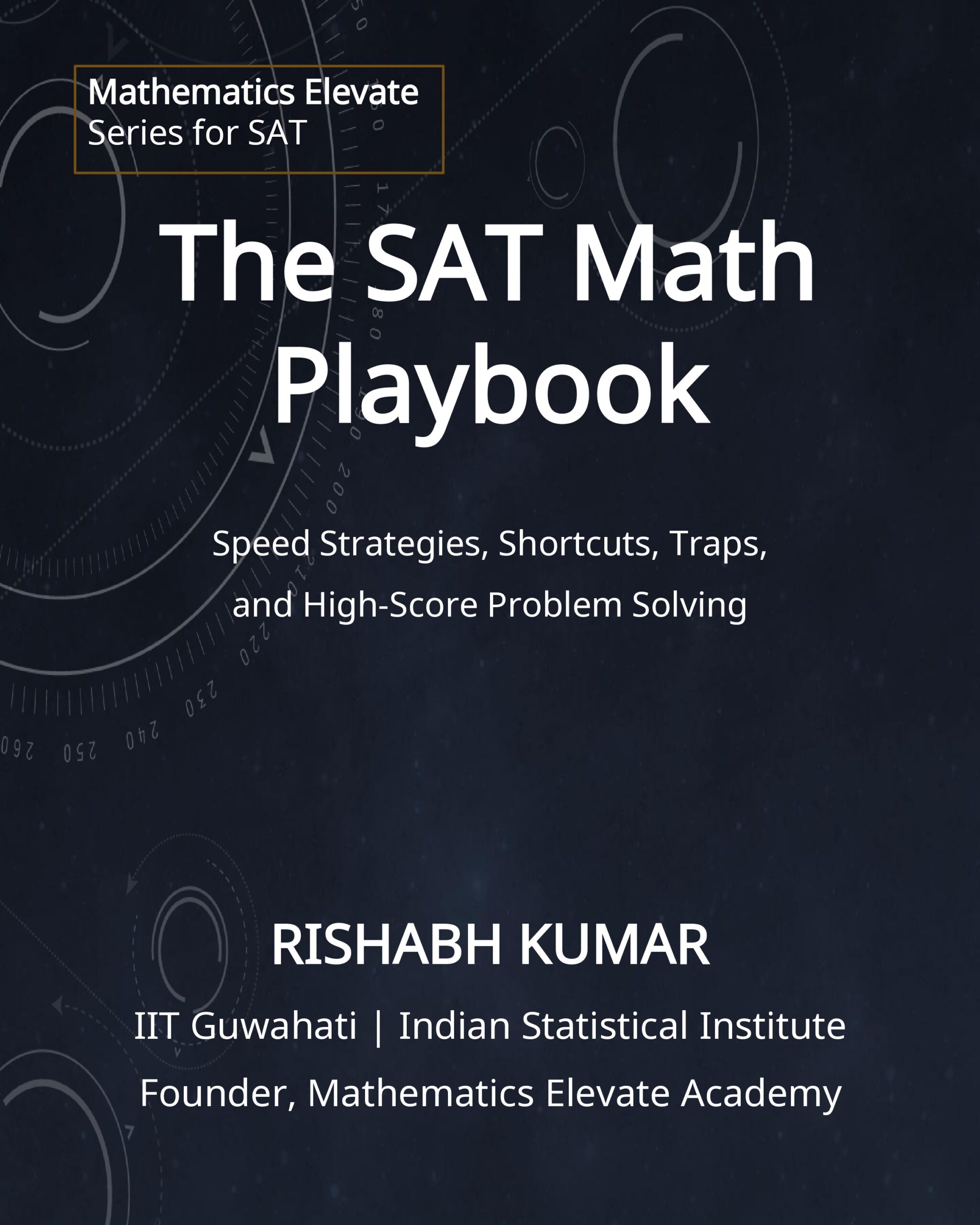
Coming Soon — Available in Kindle, Paperback, and Hardcover on Amazon
Why Most SAT Math Preparation Falls Short
Many students approach SAT Math as a standard academic subject: learn formulas, practice questions, and repeat. While this approach may lead to some improvement, it often reaches a plateau.
The reason is simple. The SAT is not only testing mathematical knowledge. It is testing decision-making under time constraints, strategic thinking, and the ability to avoid carefully designed traps.
Students with strong academic backgrounds often lose marks not because they lack knowledge, but because they:
- Choose inefficient methods
- Misinterpret questions
- Make avoidable errors under pressure
This is the gap that The SAT Math Playbook is designed to address.
A Performance-Based Approach
This book is built on a fundamental principle:
High scores come from better decisions, not just more practice.
Instead of presenting SAT Math as a list of topics, this playbook introduces a structured system focused on performance. It trains students to think strategically, execute efficiently, and maintain control under pressure.
The system is built around four core components:
- Recognition: Identifying patterns quickly
- Strategy: Selecting the most efficient method
- Execution: Solving with clarity and precision
- Error Control: Minimizing mistakes and avoiding traps
What This Book Teaches
1. The Question Recognition Engine
Students are trained to identify question types within seconds. This eliminates hesitation and allows for immediate selection of the correct approach.
2. Strategic Problem-Solving Methods
The book introduces high-efficiency techniques such as:
- Plugging in values
- Back-solving using answer choices
- Estimation and approximation
- Graphical approaches using tools like Desmos
These methods reduce complexity and save time.
3. The Trap Library
The SAT frequently includes questions designed to mislead. This book systematically prepares students to recognize and avoid:
- Partial answer traps
- Sign and calculation errors
- Unit and scale misinterpretations
- Misleading graphical representations
- Time-pressure decision errors
4. Domain-Specific Strategy Playbooks
Each major SAT Math domain is covered with a strategic focus:
- Algebra and systems of equations
- Advanced math including quadratics and functions
- Data analysis and interpretation
- Geometry and trigonometry
Each section emphasizes recognition patterns, efficient methods, and common pitfalls.
5. Speed Engineering
Students learn how to improve speed by eliminating inefficiencies rather than simply working faster. This includes:
- Identifying time loss patterns
- Applying micro-optimizations
- Improving mental math
- Using the calculator strategically
6. Error Analysis System
A structured system is provided to help students:
- Categorize mistakes
- Identify recurring patterns
- Eliminate weaknesses through targeted practice
7. Mixed Strategy Sets
Practice sets simulate real SAT conditions with mixed topics and varying difficulty. This helps students develop adaptability and decision-making under pressure.
8. Final Preparation Strategy
The book includes a focused plan for the final phase of preparation, including:
- Simulated testing
- A structured 7-day peak plan
- Test-day execution strategies
- Focus and stress management
Who This Book Is For
This book is designed for students who:
- Are scoring in the mid-range and want to move into the 700+ bracket
- Are already high scorers aiming for consistency near 800
- Want to improve not just knowledge, but performance
From Practice to Performance
Most students focus on solving more problems. However, improvement comes from solving problems more effectively.
This playbook helps students transition:
- From slow solving to strategic execution
- From repeated mistakes to controlled accuracy
- From effort-based preparation to performance-based results
Coming Soon
The SAT Math Playbook will be available in:
- Kindle Edition
- Paperback
- Hardcover
on your Amazon Marketplace.
Final Thought
The SAT is not a test of how much you know. It is a test of how well you perform under constraints.
Students who succeed are not necessarily those who practice the most, but those who:
- Recognize patterns quickly
- Choose efficient strategies
- Execute with precision
Stop solving more. Start solving smarter.
