
 admin
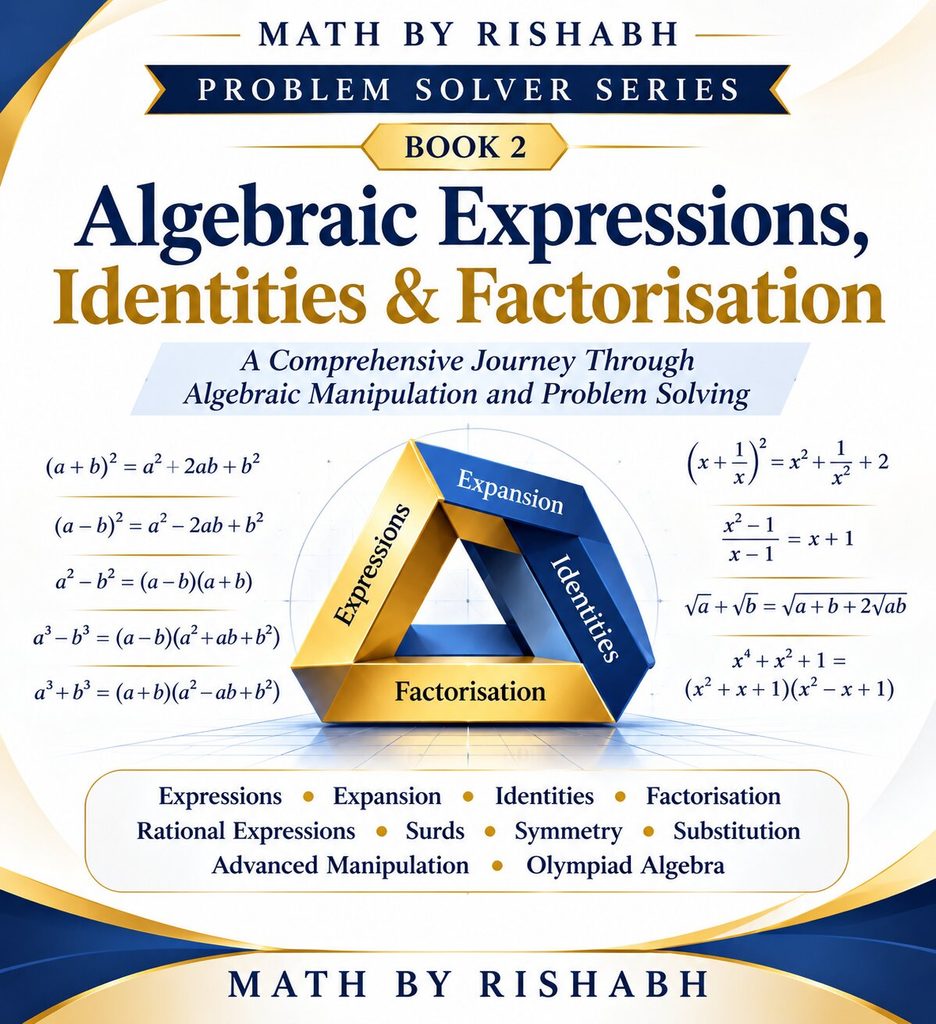
Book 2 | Math By Rishabh Problem Solver Series
By Rishabh Kumar
Algebra is one of the most important foundations of mathematics. It provides the language through which mathematical relationships are expressed, structures are recognised and complex problems are transformed into manageable forms.
However, developing genuine algebraic proficiency requires much more than memorising identities, expanding expressions or applying standard factorisation formulas. Students must learn to recognise patterns, understand mathematical structures, choose appropriate transformations and develop the confidence to manipulate unfamiliar expressions independently.
With this philosophy, I am pleased to present Algebraic Expressions, Identities & Factorisation: A Comprehensive Journey Through Algebraic Manipulation and Problem Solving, Book 2 of the Math By Rishabh Problem Solver Series.
This book is designed to take students on a structured mathematical journey, beginning with fundamental algebraic concepts and progressing towards advanced manipulation techniques and Olympiad-style problem solving.
Available now as a Kindle eBook on Amazon.
1. What Is This Book About?
Algebraic expressions, identities and factorisation form the foundation of a large part of school mathematics and advanced mathematical problem solving.
From simplifying complicated expressions to discovering hidden identities, from factorising higher-degree polynomials to manipulating rational expressions, algebra provides a collection of powerful techniques that appear throughout mathematics.
Yet students often learn these techniques as isolated procedures. They memorise formulas without fully understanding their structure, apply factorisation mechanically and struggle when a problem requires an unfamiliar combination of methods.
This book addresses that gap.
Algebraic Expressions, Identities & Factorisation develops algebra as a connected mathematical subject rather than a collection of unrelated formulas.
It focuses on:
- Understanding the structure and language of algebraic expressions.
- Developing fluency in expansion, simplification and manipulation.
- Understanding and applying important algebraic identities.
- Recognising patterns and selecting appropriate factorisation techniques.
- Working confidently with rational expressions and algebraic fractions.
- Simplifying and manipulating surds and radical expressions.
- Exploiting symmetry and strategic substitutions.
- Developing advanced algebraic techniques for non-routine problems.
- Strengthening mathematical reasoning through Olympiad-style challenges.
The central objective is to help students understand not only how an algebraic technique works, but also why it works and when it should be used.
2. Why Study Algebraic Expressions, Identities and Factorisation?
Algebraic manipulation is not an isolated mathematical skill. It is a foundation for almost every major area of advanced school mathematics.
A student who develops strong algebraic foundations is better prepared to study:
- Equations and inequalities.
- Quadratic mathematics.
- Polynomials and the theory of equations.
- Exponents, surds and logarithms.
- Functions and mathematical transformations.
- Sequences and series.
- Mathematical modelling.
- Olympiad algebra and advanced problem solving.
Consider a seemingly complicated algebraic expression. A student who relies only on routine simplification may struggle to identify the correct approach. A student with a deeper understanding of algebraic structure may recognise a hidden identity, introduce a suitable substitution or exploit symmetry to transform the problem.
That difference is central to mathematical maturity.
The purpose of this book is therefore not merely to increase computational speed. It is to develop the ability to think algebraically, recognise mathematical relationships and approach unfamiliar expressions systematically.
3. What Will You Study?
The book develops several interconnected areas of algebraic manipulation and problem solving.
A. Algebraic Expressions
Students develop an understanding of algebraic notation, expressions, terms, coefficients and the structure of algebraic forms.
The emphasis is on simplifying, interpreting and manipulating expressions accurately while recognising the relationships between their components.
The objective: Build a strong foundation for more advanced algebraic transformations.
B. Expansion and Algebraic Identities
Algebraic identities are among the most useful tools in mathematical problem solving.
Rather than treating identities as formulas to memorise, students are encouraged to understand their underlying structure and recognise how they can be applied in different situations.
The learning journey develops fluency in:
- Standard algebraic identities.
- Expansion of algebraic expressions.
- Products and powers of algebraic expressions.
- Recognising hidden identity structures.
- Applying identities strategically in complicated problems.
The objective: Develop the ability to recognise and use algebraic relationships rather than relying on mechanical expansion.
C. Factorisation
Factorisation is one of the most important skills in algebra.
It allows complicated expressions to be rewritten in simpler forms, reveals hidden relationships and provides an essential foundation for solving equations and analysing mathematical structures.
Students explore fundamental and advanced factorisation techniques, with an emphasis on recognising patterns and selecting suitable methods.
The objective: Develop flexibility and confidence in factorising algebraic expressions.
D. Rational Expressions
Rational expressions introduce another important dimension of algebraic manipulation.
Students work with algebraic fractions, their simplification, operations and structural transformations.
Understanding rational expressions also requires careful attention to restrictions on variables and the conditions under which algebraic transformations are valid.
The objective: Develop accuracy and mathematical discipline when manipulating algebraic fractions.
E. Surds and Radical Expressions
Surds and radicals frequently appear in algebraic identities, equations and advanced mathematical problems.
This area develops techniques for simplifying and manipulating radical expressions, recognising useful structures and applying appropriate transformations.
The objective: Strengthen the ability to work confidently with expressions involving irrational quantities.
F. Symmetry and Substitution
Some of the most interesting algebraic problems become manageable when their underlying structure is recognised.
Symmetry and substitution are powerful strategies for simplifying expressions and revealing relationships that are not immediately visible.
Students develop an understanding of how to:
- Recognise symmetric algebraic structures.
- Identify useful substitutions.
- Simplify complicated expressions.
- Transform problems into more manageable forms.
- Select substitutions strategically rather than arbitrarily.
The objective: Move beyond routine manipulation towards structural algebraic thinking.
G. Advanced Algebraic Manipulation
As students progress, algebraic expressions become more sophisticated and standard procedures are no longer sufficient.
Advanced manipulation requires a combination of mathematical insight, pattern recognition and strategic transformations.
This stage develops the ability to connect different algebraic techniques and use them effectively in non-routine problems.
The objective: Build the mathematical flexibility required for advanced algebraic problem solving.
H. Olympiad Algebra
Mathematical Olympiad problems frequently require students to discover an approach rather than simply apply a familiar formula.
Algebraic manipulation plays an important role in this process.
The Olympiad-oriented component encourages students to combine identities, factorisation, substitutions, symmetry and other algebraic techniques to tackle challenging problems.
The objective: Develop mathematical creativity, logical reasoning and the confidence to approach unfamiliar algebraic challenges.
4. What Makes This Book Different?
A mathematics book should do more than present formulas followed by exercises.
Students need to understand the mathematical ideas behind the methods they use. They need opportunities to explore relationships, recognise patterns, practise independently and gradually develop the ability to solve unfamiliar problems.
This book follows that broader approach.
Conceptual understanding before mechanical application
The emphasis is on understanding mathematical structures and relationships rather than memorising isolated procedures.
Connected mathematical development
Different algebraic ideas are treated as interconnected tools. Students learn how identities, factorisation, substitutions and other techniques support one another.
Progression towards advanced problem solving
The learning journey moves beyond routine exercises towards more challenging algebraic problems.
Development of independent thinking
Students are encouraged to recognise patterns, select methods and construct their own approaches rather than depend entirely on prescribed procedures.
Preparation for further mathematical study
Strong algebraic manipulation provides a foundation for subsequent topics, including equations, inequalities, quadratic mathematics, polynomials and Olympiad mathematics.
5. What Will Students Gain from This Book?
By studying the material and engaging seriously with the problems, students can develop the ability to:
- Understand and manipulate algebraic expressions accurately.
- Recognise and apply standard and advanced algebraic identities.
- Expand and factorise expressions using appropriate techniques.
- Simplify and transform rational expressions.
- Manipulate surds and radical expressions confidently.
- Recognise symmetry and exploit useful substitutions.
- Identify hidden patterns in complicated algebraic structures.
- Select appropriate techniques for non-routine problems.
- Develop logical reasoning and mathematical fluency.
- Build a stronger foundation for advanced algebra and Olympiad mathematics.
The ultimate goal is to help students become independent mathematical thinkers who can apply their knowledge beyond familiar examples.
6. Who Should Read This Book?
This book is intended for students and independent learners who want to develop a strong and deeper understanding of algebra.
Secondary and senior-secondary students
Students who want to strengthen their algebraic foundations and develop greater confidence in manipulating mathematical expressions.
Students preparing for competitive examinations
Learners who require strong algebraic skills for advanced school mathematics and competitive examinations.
Mathematical Olympiad aspirants
Students preparing for mathematical competitions who want to improve their understanding of algebraic structures, identities, factorisation and non-routine problem-solving techniques.
Independent mathematics learners
Students who enjoy exploring mathematics beyond routine textbook exercises and want to understand the subject more deeply.
Teachers and mentors
Educators seeking a structured resource for developing students’ algebraic reasoning and problem-solving abilities.
7. How Does Book 2 Fit into the Problem Solver Series?
The Math By Rishabh Problem Solver Series is designed as a connected collection of mathematics books that develops students’ understanding progressively across important mathematical subjects.
Book 2, Algebraic Expressions, Identities & Factorisation, builds upon the foundational mathematical knowledge developed in Book 1, Foundations of Mathematics.
It also establishes important algebraic foundations for subsequent books in the series:
- Book 3 — Equations & Inequalities: Extends algebraic knowledge towards equation solving and inequality techniques.
- Book 4 — Quadratic Mathematics: Develops the study of quadratic expressions, equations, functions, roots and advanced applications.
- Book 5 — Polynomials & Theory of Equations: Explores polynomial structures, roots, relationships between coefficients and advanced algebraic problems.
- Book 6 — Exponents, Surds & Logarithms: Develops the study of powers, radicals, exponential and logarithmic expressions, equations and inequalities.
Together, these books aim to provide a structured progression through important areas of algebra and advanced mathematical problem solving.
8. About the Math By Rishabh Problem Solver Series
The Math By Rishabh Problem Solver Series is built around a simple philosophy:
Learn the Concept. Understand the Mathematics. Fight the Problems. Master the Topic.
The series aims to move beyond formula-based learning and develop a deeper appreciation of mathematical ideas.
Its approach emphasises:
- Conceptual understanding.
- Mathematical intuition.
- Logical reasoning.
- Structured problem solving.
- Deliberate practice.
- Independent mathematical thinking.
The objective is to help students develop the knowledge and confidence to approach problems they have never encountered before.
9. About the Author
Rishabh Kumar is an educator, author and founder of Mathematics Elevate Academy. An alumnus of IIT Guwahati and the Indian Statistical Institute, he specialises in mathematics education and advanced problem-solving mentorship.
Through his teaching, educational resources and books, he aims to help students develop a deeper understanding of mathematics and build the skills required to approach challenging mathematical problems independently.
Website: www.mathbyrishabh.com
Mathematics Elevate Academy: www.mathematicselevateacademy.com
10. Book Details and Availability
| Detail | Information |
|---|---|
| Book | Algebraic Expressions, Identities & Factorisation |
| Series | Math By Rishabh Problem Solver Series |
| Book Number | 2 |
| Author | Rishabh Kumar |
| Format | Kindle eBook |
| Publication Status | Live on Amazon |
| Kindle Select | Enrolled |
| Kindle Preview | Available on Amazon |
This title is currently available in Kindle Edition only.
Get Your Copy
Choose your preferred Amazon marketplace:
- United States: Buy on Amazon.com
- United Kingdom: Buy on Amazon.co.uk
- Singapore: Buy on Amazon.sg
- India: Buy on Amazon.in
- France: Buy on Amazon.fr
- Germany: Buy on Amazon.de
The Kindle edition is enrolled in KDP Select, with Kindle+ availability and the Amazon Kindle Preview feature.
Explore the complete Math By Rishabh Problem Solver Series on Amazon.
Begin Your Journey Towards Algebraic Mastery
Algebra becomes powerful when students learn to recognise patterns, understand mathematical structures and choose the right approach to a problem.
Whether you are strengthening your algebraic foundations, preparing for advanced mathematics or developing your mathematical problem-solving abilities, this book is intended to support that journey.
Learn the Concept. Understand the Mathematics. Fight the Problems. Master the Topic.
Algebraic Expressions, Identities & Factorisation — Book 2 of the Math By Rishabh Problem Solver Series.
Rishabh Kumar
Educator • Author
Alumnus, IIT Guwahati and Indian Statistical Institute
Founder, Mathematics Elevate Academy
