
 admin
A more comprehensive approach to MATHCOUNTS preparation, mathematical thinking and the foundations of Olympiad problem-solving.
Mathematics competitions are often associated with speed, difficult questions and the ability to find an answer within a limited amount of time. However, beneath all these visible demands lies something much more fundamental: the ability to understand mathematics, think logically, recognise mathematical structures and solve unfamiliar problems independently.
These abilities do not develop overnight. They require a strong conceptual foundation, deliberate practice, exposure to different problem-solving approaches and, most importantly, an environment in which students learn to understand why a mathematical method works rather than simply memorising how to apply it.
With this philosophy in mind, I am pleased to announce the paperback release of The MATHCOUNTS Problem-Solving Companion, published as part of the Mathematics Elevate Series.
This release represents a substantial step forward in the development of the book. What began as an attempt to create a structured resource for MATHCOUNTS preparation gradually evolved into a much more comprehensive project: a two-volume learning pathway designed to develop mathematical understanding, problem-solving independence and competition readiness.
The second edition is not simply another attempt to present the same material. It reflects a renewed effort to make the content deeper, more organised, more carefully structured and more useful for students who want to develop lasting mathematical abilities.
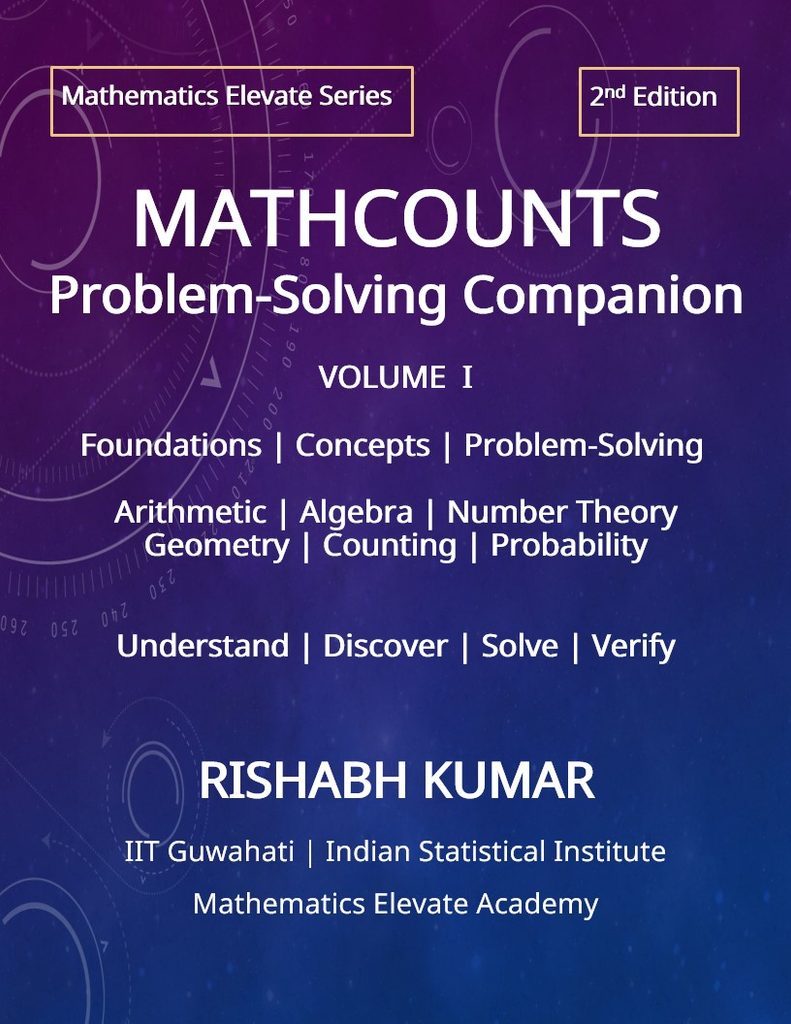
1. Why Another Edition? The Thinking Behind the Second Attempt
Writing a mathematics book is one challenge. Writing a book that genuinely helps students become better mathematical problem-solvers is a considerably different challenge.
The first attempt provided an opportunity to examine what a competition-preparation resource should accomplish. It also raised important questions:
- Does the material develop understanding, or does it merely present techniques?
- Are mathematical concepts connected in a meaningful way?
- Does the progression help students move from foundational knowledge to unfamiliar problems?
- Are students encouraged to compare different approaches?
- Is there enough opportunity for independent practice?
- Does the resource adequately address the practical demands of competition rounds?
- Can students use it to identify weaknesses, correct mistakes and measure their progress?
These questions influenced the direction of the second edition.
The objective was not simply to increase the number of pages or add more questions. The objective was to improve the learning architecture of the book.
A student should be able to move from understanding a mathematical idea to applying it, recognising when it is useful, combining it with other ideas and eventually solving problems that do not immediately reveal which technique is required.
That is the difference between learning a collection of mathematical topics and developing mathematical problem-solving ability.
Why two volumes?
As the content developed, it became increasingly clear that trying to accommodate all the instructional material, problem-solving development, competition practice, advanced challenges and complete solutions in one volume would make the book unnecessarily large and less convenient to use.
More importantly, the learning objectives deserved separate attention.
Therefore, the second edition has been organised into two complementary volumes:
Volume I — Mathematical Foundations, Core Concepts and Problem-Solving Strategies
Volume II — Competition Training, Practice Competitions and Complete Solutions
This division allows each volume to serve a distinct purpose while remaining part of one coherent learning pathway.
The result is not simply a larger book divided into two parts. It is a more deliberate approach to learning, practising and improving.
2. Volume I: Building the Mathematical Foundations
The first volume focuses on the mathematical knowledge and reasoning abilities that students need before they can consistently perform well in competitions.
A strong problem solver does not approach every question by searching for a memorised formula. Instead, the student learns to interpret the information, identify relationships, recognise patterns and select a suitable mathematical approach.
Volume I is designed to develop this foundation.
Its instructional approach places importance on:
- Conceptual understanding rather than formula memorisation.
- Mathematical definitions, conditions and relationships.
- Structured reasoning and logical development.
- Recognising patterns and mathematical structure.
- Selecting appropriate methods for unfamiliar problems.
- Understanding common errors and avoiding incorrect assumptions.
- Developing accuracy and clear mathematical communication.
- Connecting ideas across different areas of mathematics.
The intention is to help students understand the mathematics behind a problem, not merely reproduce a solution they have seen before.
This distinction becomes particularly important as competition questions become less predictable.
A familiar algebraic identity may appear in an unfamiliar setting. A geometry problem may require numerical reasoning. A counting problem may become easier after recognising a pattern. A word problem may involve several mathematical ideas working together.
Students who understand the underlying concepts are better equipped to deal with these situations.
Volume I is therefore the learning and understanding stage: developing the mathematical language, concepts and reasoning habits needed for more demanding problem-solving.
3. Volume II: Turning Understanding into Competition Performance
Understanding mathematics is essential, but competition performance requires additional preparation.
Students must learn to apply their knowledge under different conditions, work within time limits, make appropriate decisions and maintain accuracy when faced with unfamiliar questions.
Volume II addresses this practical dimension.
It provides a structured environment in which students can apply the foundations developed in Volume I through round-specific training, progressive problem sets, advanced challenges and original practice competitions.
Training for the four MATHCOUNTS rounds
The book provides dedicated preparation for the four principal competition rounds.
Sprint Round Training
The Sprint Round demands independent problem-solving without a calculator. Students must manage thirty problems within forty minutes.
The preparation focuses on numerical fluency, efficient methods, recognising structural shortcuts, allocating time and maintaining accuracy without rushing unnecessarily.
Target Round Training
The Target Round requires students to work through four pairs of problems, with six minutes allocated to each pair.
The emphasis is on planning, selecting appropriate methods, connecting the two questions within a pair and using calculator assistance selectively where permitted.
Team Round Training
The Team Round introduces an additional dimension: mathematical collaboration.
Students must distribute responsibilities, communicate clearly, work in parallel where appropriate, verify one another’s results and manage the team’s time effectively.
Countdown Round Training
The Countdown Round places considerable demands on fast recognition, mental organisation and accurate responses under pressure.
Students practise identifying mathematical structures quickly, organising calculations mentally and delivering answers confidently without allowing speed to compromise correctness.
Mixed problem sets and advanced challenges
Beyond individual round preparation, Volume II includes progressive mixed problem sets covering a broad range of mathematical topics.
Students encounter increasingly demanding problems involving arithmetic, algebra, number theory, geometry, counting, probability and integrated mathematical reasoning.
The advanced challenges are particularly important because mathematical development cannot be measured only by the number of routine questions a student completes.
Students must also learn to:
- Recognise hidden structures.
- Combine multiple mathematical ideas.
- Compare alternative solution methods.
- Handle additional restrictions and conditions.
- Generalise patterns.
- Construct and justify mathematical arguments.
Six original practice competitions
A major component of Volume II is its collection of six original practice competitions.
These provide opportunities to experience the structure of competition-style assessments and apply the techniques developed throughout the two-volume learning pathway.
The practice competitions include Sprint, Target and Team Round papers, supported by answer keys and worked solutions.
Additional Countdown practice banks provide further opportunities to strengthen fast mathematical recognition and mental reasoning.
Hints, complete solutions and deliberate improvement
A good solution resource should do more than reveal the final answer.
Students need to understand how a problem can be approached, why a particular method works, where alternative methods may be useful and what they should learn from an incorrect attempt.
Volume II therefore includes progressive hints, complete worked solutions, alternative approaches, error-analysis resources, retesting records and structured study plans.
The objective is to encourage students to become increasingly independent rather than dependent on solution manuals.
4. Why This Book? The Importance of Understanding Before Speed
One of the most common mistakes in competition preparation is treating speed as the primary objective from the beginning.
Students sometimes attempt to memorise shortcuts, practise increasingly difficult questions and measure their progress by how quickly they can produce answers.
However, speed without understanding is fragile.
A student may remember a particular technique but fail to recognise when it applies. Another may perform calculations quickly but overlook an important condition. A third may know several formulas but struggle when a problem combines ideas from different topics.
This is why the learning process should be built in a different order.
First, understand the concept. Then, recognise the structure. Next, select the method. Finally, develop speed through deliberate practice.
This sequence is central to the philosophy of the book.
Understanding creates flexibility
When students understand why a method works, they are not restricted to the exact format in which they first encountered it.
They can adapt the method, compare it with another approach and recognise when a different strategy would be more efficient.
Thinking creates independence
Mathematical thinking involves asking useful questions:
- What information is given?
- What exactly needs to be determined?
- Which relationships are relevant?
- Can the problem be simplified?
- Is there a pattern?
- Can I represent the information differently?
- Is there a more efficient approach?
- How can I verify the result?
These habits gradually become part of a student’s natural approach to mathematics.
Problem-solving creates adaptability
The most valuable competition problems are often those that cannot be solved by immediately applying a familiar formula.
They require students to explore, experiment, make connections, test possibilities and sometimes reconsider an initial approach.
The ability to work through these situations is what makes mathematical problem-solving a transferable skill.
5. From MATHCOUNTS to Olympiad Mathematics: A Longer Mathematical Journey
MATHCOUNTS can be an important early stage in a student’s mathematical development.
It introduces students to non-routine problems, mathematical reasoning, competition conditions and the satisfaction of discovering an elegant solution.
However, competition mathematics does not end with MATHCOUNTS.
For students who develop a deeper interest in mathematics, there are further opportunities to explore increasingly challenging problems through national and international competition pathways.
The exact structure, eligibility requirements and selection procedures differ between countries. Nevertheless, several pathways illustrate how students can gradually progress towards advanced Olympiad mathematics.
The United States pathway
For students following the United States mathematics competition system, a broad progression may look like this:
MATHCOUNTS → AMC 8 → AMC 10 / AMC 12 → AIME → USAJMO / USAMO → IMO selection pathway
These competitions have different purposes and levels of mathematical demand.
- MATHCOUNTS: Develops early competition problem-solving, numerical fluency and mathematical reasoning.
- AMC 8: Introduces students to a broader range of middle-school competition mathematics.
- AMC 10 and AMC 12: Develop deeper mathematical reasoning across algebra, geometry, number theory, counting and other areas.
- AIME: Requires more substantial multi-step reasoning and the ability to solve challenging problems with integer answers.
- USAJMO and USAMO: Provide a transition towards proof-based Olympiad mathematics, where constructing rigorous arguments becomes central.
- IMO: Represents the international level of mathematical Olympiad competition, reached through the national selection process.
This is a broad educational progression, not a mandatory sequence. Students may enter competitions at different stages depending on their age, preparation and eligibility.
The United Kingdom pathway
For students following the UK mathematics competition system, a commonly recognised progression includes:
UKMT Intermediate and Senior Mathematical Challenges → British Mathematical Olympiad Round 1 (BMO1) → British Mathematical Olympiad Round 2 (BMO2) → UK International Mathematical Olympiad selection pathway → IMO
The Senior Mathematical Challenge (SMC) is an important competition for developing mathematical problem-solving at a higher school level.
Students who perform strongly may progress through further rounds and selection opportunities, depending on the applicable UKMT arrangements and eligibility criteria.
BMO1 and BMO2 place greater emphasis on sustained mathematical reasoning and proof-style solutions.
The transition from short-answer competition questions to constructing complete mathematical arguments is a particularly important development.
Other national pathways
Many other countries have their own mathematical competition structures and Olympiad selection systems.
For example, students may progress through:
- National mathematics challenges.
- Regional and state-level competitions.
- National Olympiad qualifying examinations.
- Advanced national Olympiad rounds.
- Training camps and selection tests.
- International Mathematical Olympiad team selection.
The names and structures vary, but the underlying mathematical demands share important similarities.
Students must understand concepts, recognise mathematical structures, reason carefully and solve problems that require more than routine application.
What is common across these pathways?
The competitions may differ in format, syllabus, difficulty and assessment style.
Some emphasise rapid problem-solving. Others require numerical answers, extended solutions or rigorous proofs.
Yet three abilities remain fundamental:
Understanding. Thinking. Problem-solving.
These are not skills that become relevant only when a student reaches advanced Olympiad mathematics. They are developed much earlier, through consistent engagement with meaningful mathematical problems.
That is why building strong foundations at the MATHCOUNTS stage matters.
6. The Step-Ladder Approach: Preparing for More Than One Competition
One of the motivations behind developing this book is the belief that mathematics preparation should create long-term learning value.
Students should not approach every competition as an isolated examination.
Instead, they should gradually develop abilities that remain useful as they encounter more demanding mathematical problems.
Consider the progression:
Stage 1 — Mathematical Foundations
Develop numerical fluency, algebraic understanding, geometric reasoning, counting techniques and logical thinking.
Stage 2 — MATHCOUNTS and Early Competition Mathematics
Learn to apply mathematical knowledge to unfamiliar problems, recognise patterns and work accurately under time constraints.
Stage 3 — AMC 8 and Other Middle-School Competitions
Expand mathematical versatility and become comfortable with a wider range of competition-style problems.
Stage 4 — AMC 10 / AMC 12, SMC and Comparable National Challenges
Develop stronger multi-step reasoning, more advanced mathematical connections and greater independence in selecting methods.
Stage 5 — AIME, BMO and Advanced National Rounds
Engage with more demanding problems that require persistence, deeper analysis and creative mathematical thinking.
Stage 6 — USAJMO / USAMO, BMO2 and National Olympiad Selection
Move towards rigorous proof construction, mathematical precision and sophisticated problem-solving.
Stage 7 — International Olympiad Mathematics
Develop the ability to explore, prove and communicate solutions to challenging mathematical problems at the highest international competition level.
This progression should not be understood as a guarantee that completing one book or one competition automatically prepares a student for the next.
Each stage requires additional study, suitable mathematical content and sustained practice.
Nevertheless, the underlying abilities developed through good foundational preparation provide an important starting point.
The purpose of this book is to strengthen that starting point and establish habits of thinking that students can continue to develop throughout their mathematical journey.
7. Accuracy, Structure and the Effort Behind the Book
A detailed mathematics book requires more than writing explanations and assembling questions.
Every mathematical statement must be considered carefully. Definitions must be precise, conditions must be stated, solutions must be logically consistent and the progression of ideas must make educational sense.
For a competition-preparation resource, accuracy is especially important.
A small oversight in a numerical condition, a geometric assumption or a counting argument can change the entire answer.
The development of this edition therefore involved considerable attention to:
- Mathematical correctness and consistency.
- Clear problem statements and unambiguous conditions.
- Appropriate notation and terminology.
- Logical completeness of worked solutions.
- Consistency between questions, answers and explanations.
- Progressive organisation of problem difficulty.
- Clear separation between foundational, standard and advanced material.
- The relationship between instructional content and competition practice.
The second edition also reflects the effort required to organise a large amount of mathematical content into a usable learning structure.
The two-volume format is part of that effort.
Instead of treating every problem as an isolated exercise, the material is organised to support a broader process: learning, applying, reviewing, correcting and improving.
Accuracy is not simply a final proofreading exercise. It is a continuing commitment throughout mathematical writing and revision.
8. Who Should Use This Book?
The two volumes are intended for a range of students and educators.
Students beginning MATHCOUNTS preparation
Students can use Volume I to develop the mathematical foundations and reasoning habits required for competition-style questions.
Students with previous competition experience
Students who already understand the basic concepts can use the material to strengthen weak areas, improve their methods and develop greater independence.
Students preparing for AMC 8 and other middle-school competitions
The mathematical reasoning and problem-solving development can provide a useful foundation for students moving towards broader competition mathematics.
Students interested in Olympiad mathematics
Students who want to explore more challenging mathematical problems can use the two-volume pathway to strengthen the conceptual and problem-solving abilities that support further study.
Teachers, tutors and mathematics coaches
The books can support structured instruction, enrichment sessions, independent practice, revision and competition preparation.
The material can be used sequentially or selectively, depending on the student’s existing mathematical background.
9. How to Use the Two Volumes Effectively
The most productive way to use a mathematics resource is not necessarily to complete every question as quickly as possible.
A more deliberate approach is often more effective.
I recommend the following study process:
Step 1: Understand the concept.
Read the relevant explanations and identify the mathematical ideas involved. Do not move forward simply because you recognise a formula.
Step 2: Study the methods.
Work through examples carefully. Understand why each step is valid and identify alternative approaches where appropriate.
Step 3: Solve independently.
Attempt problems without immediately consulting the solution. Give yourself enough time to explore different methods.
Step 4: Review mistakes.
Identify whether an error occurred because of a conceptual gap, incorrect interpretation, calculation, algebraic manipulation or an unsuitable strategy.
Step 5: Reattempt unfamiliar problems.
After reviewing a solution, return to a related problem that you have not previously attempted. This helps determine whether you have actually learned the underlying method.
Step 6: Introduce timed practice.
Once the concepts and methods are reasonably secure, begin practising under competition-style time constraints.
Step 7: Reflect and improve.
Track accuracy, independence, problem-solving efficiency and the ability to handle unfamiliar questions.
This process is more meaningful than measuring progress through speed alone.
10. A Note to Students: Learn to Enjoy the Process of Thinking
Not every mathematical problem should be solved immediately.
Some problems require experimentation. Some require several attempts. Others become understandable only after recognising a connection that was initially hidden.
That is a normal and valuable part of mathematical learning.
When students encounter a difficult problem, they should not automatically assume that they lack the ability to solve it.
Instead, they should learn to ask:
- Have I understood the problem correctly?
- Can I represent the information differently?
- What happens in a simpler case?
- Can I identify a pattern?
- Which mathematical ideas might be connected?
- Can I test an approach and learn from the result?
The process of thinking through a problem is itself an important part of mathematical development.
Over time, students begin to recognise that mathematics is not merely a subject of calculations. It is a way of reasoning about structures, relationships and patterns.
That mindset can remain valuable far beyond any particular examination or competition.
11. Get Your Paperback Copies
The paperback edition of The MATHCOUNTS Problem-Solving Companion is available through Amazon marketplaces.
Amazon Paperback — Volume I
- United States: Buy on Amazon.com
- United Kingdom: Buy on Amazon.co.uk
- Singapore: Buy on Amazon.sg
Readers in other countries can search for the book using its ASIN:
B0HQFHSXCW
Availability, delivery options and pricing may vary by marketplace and location.
12. The Beginning of a Longer Mathematical Journey
The release of this paperback edition is an important milestone, but the larger objective extends beyond the publication of a book.
The intention is to create a resource that helps students build mathematical understanding, develop independent thinking and become more confident when facing unfamiliar problems.
MATHCOUNTS can be an excellent starting point. AMC competitions, national mathematical challenges and Olympiad programmes can provide further opportunities to explore increasingly sophisticated mathematics.
But the foundation remains the same.
A student who learns to understand a concept deeply, think logically, recognise patterns and construct a sound solution is developing abilities that extend well beyond one competition.
That is the philosophy behind the two-volume structure.
Volume I builds the foundations.
Volume II develops competition readiness.
Together, they aim to help students move from understanding mathematical ideas to applying them with confidence and independence.
Because, ultimately, the goal of mathematics education should not be limited to producing faster answers.
It should be to develop better mathematical thinkers.
The MATHCOUNTS Problem-Solving Companion
Mathematical Foundations. Competition Training. Independent Thinking.
A two-volume publication from the Mathematics Elevate Series.
Author: Rishabh Kumar
Founder, Mathematics Elevate Academy
Mathematics Elevate Academy
Math By Rishabh
An independent educational resource. This publication is not affiliated with or endorsed by the MATHCOUNTS Foundation, the Mathematical Association of America, the United Kingdom Mathematics Trust or the International Mathematical Olympiad.
