
 admin
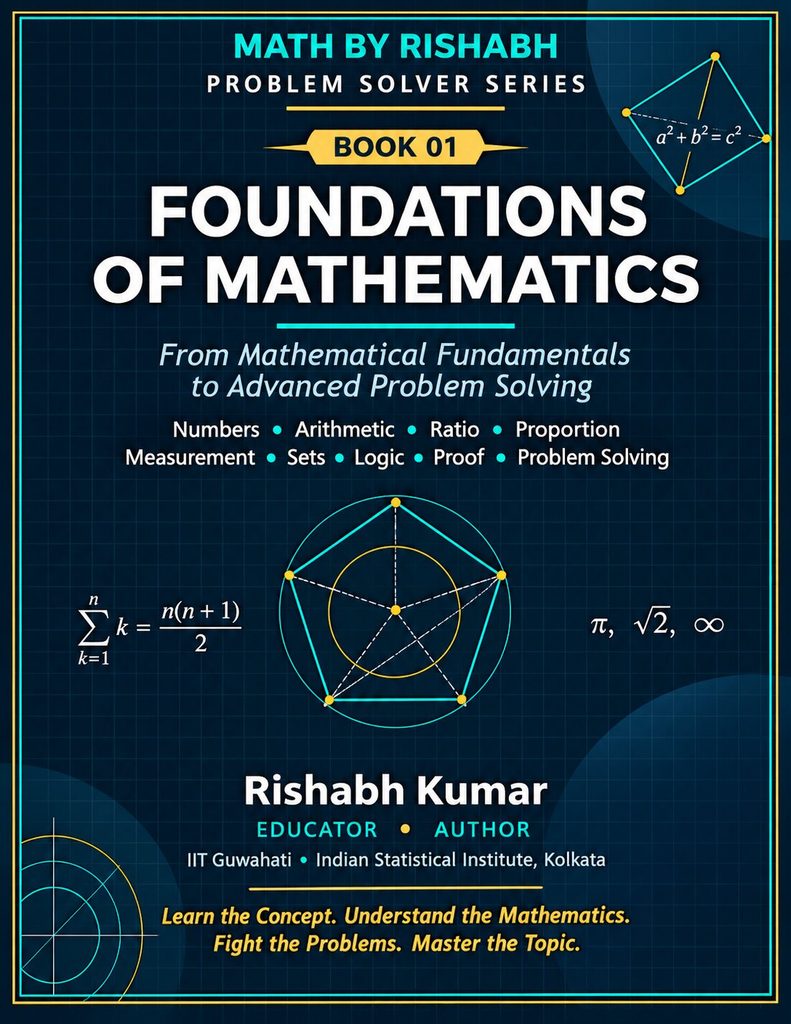
The first book in the Math By Rishabh Problem Solver Series is now available on Amazon Kindle.
Mathematics is often approached as a subject of formulas, calculations, rules and procedures. Students learn techniques, practise standard exercises and become familiar with familiar question patterns. Yet, when confronted with an unfamiliar problem, many discover that knowing a formula and understanding the mathematics behind it are two very different things.
True mathematical development requires more than procedural fluency. It requires conceptual understanding, logical reasoning, careful interpretation, strategic thinking and the ability to approach unfamiliar situations independently.
This philosophy lies at the heart of the Math By Rishabh Problem Solver Series.
We are pleased to announce the release of its first book:
Foundations of Mathematics
From Mathematical Fundamentals to Advanced Problem Solving
By Rishabh Kumar
Learn the Concept. Understand the Mathematics. Fight the Problems. Master the Topic.
The Kindle edition is now live on Amazon, introducing readers to a comprehensive mathematical learning experience that begins with fundamental concepts and progressively develops the reasoning and problem-solving skills needed to engage with more demanding mathematics.
Get the Kindle Edition on Amazon
1. Why Foundations of Mathematics Matter
A strong mathematical foundation is not simply about being able to perform arithmetic accurately. It is about understanding the mathematical language, structures and relationships that make more advanced mathematics possible.
Consider the progression from understanding numbers to working with fractions, ratios, percentages, powers, roots, measurement, sets and mathematical notation.
These subjects are sometimes taught as separate chapters or isolated techniques. However, they are deeply interconnected.
Understanding fractions strengthens proportional reasoning. Understanding powers and roots prepares students for algebraic manipulation. Ratio and variation develop quantitative reasoning. Sets and intervals introduce important mathematical structures and precise language.
Most importantly, these ideas provide the foundation for approaching increasingly sophisticated mathematical problems.
A student who understands the underlying mathematics can do more than reproduce a demonstrated method. They can recognise when a method is appropriate, adapt it to unfamiliar situations and develop their own approaches.
This is the distinction between learning mathematics procedurally and learning to think mathematically.
Foundations of Mathematics is designed around this deeper objective.
2. Introducing the Book
Foundations of Mathematics: From Mathematical Fundamentals to Advanced Problem Solving is Book 1 of the Math By Rishabh Problem Solver Series.
The book develops mathematical understanding through a structured progression of concepts, explanations, examples, problem-solving strategies and extensive exercises.
Rather than treating foundational mathematics as a collection of elementary topics, it approaches the subject as an interconnected system of ideas.
Readers begin by exploring what mathematics is, how mathematical statements are interpreted and how mathematical conventions are used. From there, the book develops number systems, arithmetic, quantitative reasoning, measurement and mathematical language.
The learning experience is designed to move beyond routine exercises. Students are encouraged to examine mathematical ideas carefully, identify relationships, develop strategies and engage with problems that require more than immediate formula application.
The objective is not simply to finish a chapter. It is to develop the ability to use the mathematics independently.
3. What Does the Book Cover?
The book is organised into major thematic parts, each developing an important component of mathematical understanding.
Part I: The Language and Structure of Mathematics
Before studying mathematical techniques, students need to understand the language through which mathematics is expressed.
This opening part introduces the nature of mathematics, mathematical statements, conventions and the development of productive mathematical habits.
It encourages students to become more careful readers and interpreters of mathematical information.
Topics include:
- Understanding what mathematics is.
- Reading and interpreting mathematical statements.
- Mathematical conventions.
- Developing productive mathematical habits.
- Introductory problem-solving challenges.
The emphasis is on developing a thoughtful approach to mathematical learning from the beginning.
Part II: Arithmetic Foundations
Arithmetic is one of the most important building blocks of mathematical development.
However, understanding arithmetic involves considerably more than performing calculations. Students need to understand number structures, operation properties, representations and the relationships between different forms of numbers.
This part develops:
- Natural numbers, whole numbers and integers.
- Rational, irrational and real numbers.
- Addition, subtraction, multiplication and division.
- Properties of arithmetic operations.
- Order of operations.
- Factors, multiples and Euclidean division.
- Fractions and equivalent fractions.
- Comparing and operating with fractions.
- Decimal representation and decimal operations.
- Relationships between fractions and decimals.
- Powers and laws of exponents.
- Squares, square roots, cubes and cube roots.
- Introduction to surds.
- Scientific notation and orders of magnitude.
The book also explores problem-solving applications of these topics, encouraging students to understand the structure behind numerical calculations.
Part III: Approximation, Measurement, and Quantitative Reasoning
Mathematics becomes especially powerful when students can use it to interpret quantities, compare relationships and solve practical problems.
This part extends the mathematical foundations developed earlier and introduces a broader approach to quantitative reasoning.
Topics include:
- Rounding and estimation.
- Bounds and errors.
- Accuracy and precision.
- Ratio and proportion.
- Compound ratios.
- Percentages and percentage change.
- Successive percentage changes.
- Rates and compound measures.
- Speed, distance and time.
- Density and other compound measures.
- Direct and inverse variation.
- Commercial mathematics.
- Profit, loss, discounts and markups.
- Taxation and interest.
- Compound growth and personal financial mathematics.
- Units, measurement and scale.
- Dimensional reasoning.
These topics provide opportunities to connect mathematical concepts with real-world situations while developing the ability to interpret and solve quantitative problems.
Part IV: Sets, Intervals, and Mathematical Language
Mathematical precision depends on understanding the language and structures used to describe mathematical objects and relationships.
This part introduces sets, intervals and symbolic mathematical language.
Topics include:
- The idea and types of sets.
- Subsets and set operations.
- Venn diagrams.
- Laws of sets.
- The real number line.
- Intervals and interval notation.
- Operations with intervals.
- Relationships between intervals and sets.
- Mathematical notation and symbolic language.
These ideas are important for developing the mathematical precision required in more advanced subjects.
4. More Than Explanations: A Problem-Solving Approach
One of the defining characteristics of the Math By Rishabh Problem Solver Series is its emphasis on active problem solving.
Understanding a concept is only the beginning. Students must learn how to apply it, recognise when it is useful and adapt it to different mathematical situations.
For this reason, the book incorporates several learning components throughout its chapters.
Problem-Solving Warm-Ups and Challenges
Students encounter opportunities to engage with mathematical problems and activate their reasoning before moving further into a topic.
Strategy Toolkits
Dedicated strategy toolkits help consolidate important approaches and techniques associated with the chapter’s subject matter.
Chapter Problems
Extensive chapter exercises provide opportunities to apply concepts, practise techniques and develop greater mathematical fluency.
Chapter Summaries
Summaries help readers revisit the central ideas and organise their understanding.
Reflection
Reflection encourages students to think about their learning, their approaches to problems and the mathematical ideas they have developed.
This structure aims to make the reader an active participant in the learning process rather than a passive consumer of explanations.
5. From Fundamental Concepts to More Challenging Problems
The title of this book deliberately emphasises progression.
The objective is not to remain at the level of elementary mathematical operations. Instead, the book aims to establish the conceptual understanding and reasoning habits that support increasingly challenging problem solving.
For example:
- Understanding number systems provides the language for classifying and analysing numbers.
- Arithmetic properties help students recognise structure and simplify calculations.
- Fractions, decimals, powers and roots develop numerical fluency and flexibility.
- Ratio, proportion and variation strengthen the ability to analyse relationships between quantities.
- Approximation and measurement develop quantitative judgement.
- Sets and intervals introduce precise mathematical descriptions and structures.
These connections help students appreciate mathematics as a coherent discipline rather than a disconnected collection of topics.
The book is intended to provide a foundation upon which students can continue developing their mathematical abilities.
6. Who Should Read This Book?
Foundations of Mathematics is intended for students and independent learners who want to develop a deeper and more systematic understanding of mathematics.
It may be particularly useful for:
Students Strengthening Their Mathematical Foundations
Learners who want to revisit fundamental concepts, identify gaps in their understanding and develop greater confidence in mathematics.
Students Preparing for More Advanced Mathematics
Students progressing towards algebra, geometry, number theory, combinatorics, calculus and other advanced mathematical subjects can benefit from strengthening the foundations on which these subjects depend.
Independent Learners
Readers who enjoy exploring mathematical ideas and want to develop the ability to approach problems independently.
Teachers, Parents and Mentors
Educators and mentors looking for a structured resource that combines conceptual explanations, mathematical practice and problem-solving development.
The book is not intended merely to help students complete routine exercises. Its broader objective is to encourage mathematical independence and deeper understanding.
7. The Math By Rishabh Philosophy
The Math By Rishabh Problem Solver Series is guided by a simple but important philosophy:
Read carefully.
Understand deeply.
Attempt independently.
Struggle productively.
Learn from mistakes.
Return to difficult problems.
And keep thinking.
Mathematical progress does not always happen immediately.
Sometimes a problem requires several attempts. Sometimes an initial approach fails. Sometimes the most important learning occurs when a student returns to a problem after examining why an earlier method did not work.
These experiences are not obstacles to mathematical learning. They are essential parts of it.
The purpose of problem solving is not simply to arrive at an answer as quickly as possible. It is to understand the reasoning that leads to that answer.
Mathematics becomes yours when you can use it without being told what to do.
This principle shapes the learning experience throughout the series.
8. About the Math By Rishabh Problem Solver Series
The Math By Rishabh Problem Solver Series is an educational book collection developed to help students build mathematical understanding and strengthen their problem-solving abilities.
The series is intended to progress across mathematical topics, connecting foundational learning with deeper conceptual development and increasingly challenging problems.
Rather than focusing exclusively on memorising formulas or following standard procedures, the series emphasises:
- Conceptual clarity.
- Mathematical reasoning.
- Logical thinking.
- Problem-solving strategies.
- Independent attempts.
- Extensive mathematical practice.
- Learning through productive struggle.
- Long-term mathematical development.
Foundations of Mathematics establishes the starting point for this learning journey.
Further books in the series will extend the same philosophy to additional mathematical topics.
9. About the Author
Rishabh Kumar is a mathematics educator, author and founder of Mathematics Elevate Academy.
An alumnus of IIT Guwahati and the Indian Statistical Institute.
With over eight years of teaching and mentoring experience, he works with ambitious students across different curricula and mathematical disciplines, helping them develop conceptual understanding, independent reasoning and advanced problem-solving skills.
Through his books and educational initiatives, he aims to make rigorous mathematical learning accessible while encouraging students to think deeply, approach unfamiliar problems and develop lasting mathematical confidence.
10. Get Your Copy on Amazon Kindle
Foundations of Mathematics: From Mathematical Fundamentals to Advanced Problem Solving is now available as a Kindle eBook.
Book: Foundations of Mathematics
Series: Math By Rishabh Problem Solver Series
Book Number: 1
Author: Rishabh Kumar
Format: Kindle eBook
Amazon Price: US $12.99 (Kindle+ Enrolled)
ASIN: B0H73J33QL
GET YOUR KINDLE EDITION ON AMAZON
Begin with the foundations. Develop your mathematical thinking. Learn to approach problems independently.
Learn the Concept. Understand the Mathematics. Fight the Problems. Master the Topic.
Math By Rishabh Problem Solver Series
Published by Mathematics Elevate Academy
