
 admin
Introducing a new book from the Mathematics Elevate Series by Mathematics Elevate Academy.
There is something particularly fascinating about combinatorics.
A problem may begin with a seemingly simple question: How many arrangements are possible? How many selections can be made? Must a particular configuration exist? Is a certain outcome unavoidable?
Yet, finding the answer can require much more than counting.
Sometimes the key lies in recognizing a hidden correspondence. Sometimes it involves identifying an invariant, choosing an extremal configuration, or examining the same mathematical object from two different perspectives. A problem that initially appears complicated may eventually yield to one remarkably simple observation.
This is the nature of Olympiad combinatorics.
It is a subject where mathematical creativity, logical reasoning, structural understanding, and proof construction come together.
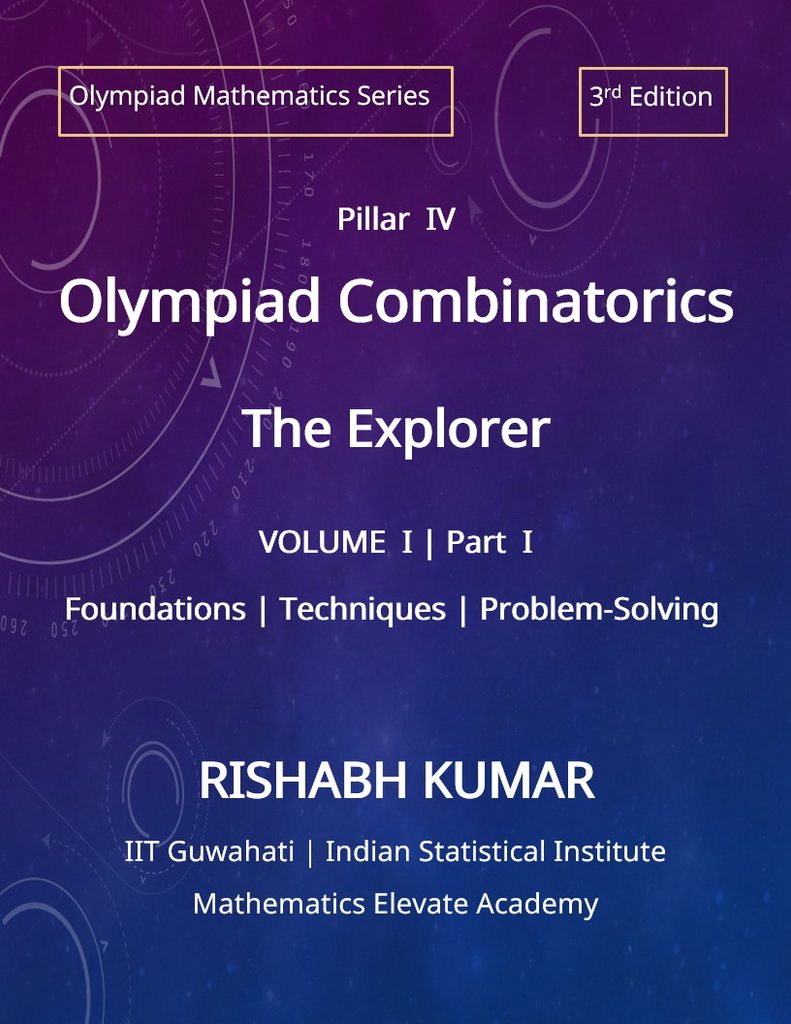
With this philosophy in mind, Mathematics Elevate Academy is pleased to introduce Olympiad Combinatorics: Volume I — The Explorer, Part I, a new publication under the Mathematics Elevate Series.
The book is designed to help students develop a systematic understanding of combinatorial mathematics and build the problem-solving foundations required for mathematical Olympiads.
Why Combinatorics Is More Than Counting
Combinatorics is often introduced through permutations, combinations, and elementary counting principles. These topics provide essential foundations, but Olympiad combinatorics extends considerably further.
The real challenge is frequently not knowing a formula, but recognizing which mathematical idea makes a problem solvable.
Consider a few fundamental questions:
- How can we count a collection of objects without overcounting?
- How can two different counting arguments establish an unexpected identity?
- How can we prove that a particular configuration must exist?
- How can a complicated mathematical process be understood through an invariant?
- How can a one-to-one correspondence simplify a difficult counting problem?
- How can selecting a maximal or minimal object reveal a hidden mathematical property?
These questions illustrate the depth of combinatorial reasoning.
The ability to solve them develops skills that extend well beyond a single mathematical topic. Students learn to investigate unfamiliar situations, identify useful structures, formulate conjectures, and construct rigorous arguments.
This is precisely the kind of mathematical thinking that serious Olympiad preparation should develop.
Introducing The Explorer
Olympiad Combinatorics: Volume I — The Explorer, Part I is designed as a structured introduction to the fundamental ideas and techniques of Olympiad combinatorics.
The central objective is not simply to introduce mathematical results, but to help students understand the reasoning behind them.
A technique should not be treated as an isolated formula to memorize. Students should understand why it works, when it becomes useful, and how it can be combined with other mathematical ideas.
The book therefore emphasizes three interconnected aspects of learning:
Conceptual understanding: Developing familiarity with mathematical definitions, principles, structures, and fundamental results.
Problem-solving techniques: Understanding how different combinatorial methods can be applied to mathematical situations.
Mathematical maturity: Developing the ability to reason independently, construct proofs, and approach unfamiliar problems systematically.
The intention is to take students beyond routine counting exercises and introduce them to the deeper mathematical thinking that characterizes Olympiad problem solving.
US: https://www.amazon.com/dp/B0HRL4RFKZ
UK: https://www.amazon.co.uk/dp/B0HRL4RFKZ
What Does the Book Cover?
The first part develops a broad foundation in combinatorial mathematics through several important topics and techniques.
Fundamental Counting Principles
Counting is the starting point of combinatorics, but systematic counting requires precision.
Students explore how to organize possibilities, distinguish between different counting situations, and construct arguments that avoid omissions and overcounting.
Permutations and Combinations
Arrangements and selections are central to elementary combinatorics.
Understanding the distinction between ordered and unordered choices, as well as the effects of restrictions, provides essential preparation for more sophisticated problems.
Binomial Coefficients
Binomial coefficients connect counting arguments with algebraic identities and combinatorial relationships.
Their properties provide useful tools for developing identities and understanding structured counting problems.
The Pigeonhole Principle
One of the most powerful elementary principles in Olympiad mathematics, the Pigeonhole Principle establishes the existence of particular objects or configurations under suitable conditions.
Its applications demonstrate how a simple counting observation can produce surprisingly strong mathematical conclusions.
Double Counting
Double counting is an important strategy in which the same mathematical quantity is counted in two different ways.
The resulting equality can reveal relationships and identities that are not immediately obvious from a direct approach.
The Principle of Inclusion-Exclusion
When objects satisfy overlapping conditions, straightforward counting may lead to overcounting.
The Principle of Inclusion-Exclusion provides a systematic framework for correcting this and obtaining accurate counts.
Recurrence Relations
Many combinatorial quantities are naturally connected to smaller instances of the same problem.
Recurrence relations provide a framework for understanding these relationships and developing systematic counting arguments.
Bijective Arguments
A bijection establishes a one-to-one correspondence between two mathematical sets.
Recognizing such correspondences can transform a difficult problem into a simpler one and reveal unexpected connections between different combinatorial structures.
Invariants and Monovariants
Invariants and monovariants are particularly useful when studying mathematical processes involving repeated operations or transformations.
They help establish what remains unchanged, what changes consistently, and which outcomes are possible or impossible.
Colouring Methods and the Extremal Principle
Colouring arguments provide useful representations of mathematical configurations, while the Extremal Principle uses maximal or minimal objects to reveal structural properties.
Both techniques are valuable tools for approaching non-routine combinatorial problems.
Together, these topics establish a substantial foundation for further exploration of Olympiad combinatorics.
Developing the Ability to Think Mathematically
One of the most important distinctions between routine mathematics and Olympiad mathematics is the role of independent reasoning.
In a routine exercise, the relevant formula or procedure may be relatively obvious. In an Olympiad problem, the student must often discover the appropriate approach.
This requires a different mindset.
Instead of immediately searching for a familiar formula, students should learn to ask:
- What exactly is given, and what must be established?
- Can the problem be understood through smaller examples?
- Is there a hidden pattern or structural relationship?
- Can the problem be represented or counted in another way?
- Which mathematical principle might be relevant?
- Can the proposed argument be justified completely?
These questions encourage a disciplined approach to problem solving.
A student may initially struggle to identify the right technique. However, through sustained practice, mathematical observations become more meaningful, connections become easier to recognize, and unfamiliar problems become less intimidating.
The goal is not to memorize hundreds of solutions. It is to develop the ability to discover solutions.
Why Is This Book Divided into Two Parts?
The content of Volume I: The Explorer is extensive. To make the physical publication more manageable, it has been divided into two parts.
However, Part I and Part II together constitute one unified Volume I. The division is primarily for publication and physical-format considerations, rather than a separation into different levels of mathematical difficulty.
Part I establishes the foundations and develops the essential combinatorial techniques.
Part II continues the exploration through further combinatorial structures and applications, including:
- Graphs and Networks
- Lattice Paths and Grid Combinatorics
- Further combinatorial techniques and problem-solving synthesis
- Writing complete Olympiad solutions
- Technique-based problem-solving drills
- National Olympiad training sets and challenges
- Full-length national Olympiad simulations
This progression is intended to help students consolidate their understanding and apply the techniques they have learned to increasingly challenging mathematical problems.
The next major stage is Volume II: The Olympian, which will extend the mathematical journey towards advanced national Olympiad and IMO-level problem solving.
The Larger Vision: Olympiad Mathematics Series
Olympiad Combinatorics is part of the Olympiad Mathematics Series, developed under the Mathematics Elevate Series imprint by Mathematics Elevate Academy.
The programme is organized around four major pillars of Olympiad mathematics:
- Number Theory
- Algebra
- Combinatorics
- Geometry
Each pillar follows a progressive two-volume structure.
Volume I: The Explorer develops foundational concepts, essential techniques, mathematical fluency, and structured problem-solving strategies, progressing towards national Olympiad readiness.
Volume II: The Olympian builds upon these foundations through advanced mathematical ideas, sophisticated techniques, challenging national Olympiad problems, and IMO-level preparation, including selected problems from the IMO Shortlist.
The purpose of this architecture is to provide students with a coherent learning pathway rather than an isolated collection of mathematical books.
The different titles in the series are being developed and released progressively. Some books are already available, while others are forthcoming and will be published as their content is finalized.
Who Should Explore This Book?
This book is intended for students who want to develop a deeper understanding of combinatorics and prepare for challenging mathematical competitions.
It is particularly relevant to:
- Students preparing for national mathematical Olympiads.
- Gifted and mathematically curious secondary-school students.
- Learners interested in advanced counting and discrete mathematics.
- Students seeking to strengthen their mathematical reasoning and proof-writing abilities.
- Mathematics educators and mentors looking for structured combinatorics material.
The most important requirement is curiosity and a willingness to engage with challenging problems.
Some questions will have elegant and immediate solutions. Others may require several attempts, alternative approaches, and considerable persistence.
Both experiences are valuable.
About Mathematics Elevate Academy
Mathematics Elevate Academy is an educational initiative dedicated to developing mathematical understanding, advanced problem-solving abilities, and intellectual curiosity.
Through its educational resources, publications, and mentorship programmes, the academy supports students pursuing demanding mathematical curricula and competitive examinations.
The Mathematics Elevate Series represents its publishing initiative, bringing together structured learning resources across different areas of mathematics.
The Olympiad Mathematics Series is an important part of this initiative, with the objective of helping students develop the mathematical foundations, techniques, and maturity required for serious Olympiad preparation.
Explore the Book
Olympiad Combinatorics: Volume I — The Explorer, Part I marks the beginning of a comprehensive journey through combinatorial mathematics.
It is an invitation to look beyond formulas, investigate mathematical structures, recognize hidden relationships, and develop the ability to construct rigorous solutions independently.
Because ultimately, the real value of studying Olympiad mathematics lies not merely in finding answers, but in learning how to think.
Explore the ideas. Understand the structures. Develop the reasoning. Build the solution.
About the Author
Rishabh Kumar is a mathematics educator, author, and founder of Mathematics Elevate Academy. He holds a Master’s degree in Applied Statistics from the Indian Statistical Institute, Kolkata, and has over seven years of teaching and mentoring experience.
Through the Mathematics Elevate Series, he aims to develop rigorous mathematical learning resources that encourage conceptual understanding, independent reasoning, and advanced problem-solving abilities.
Discover Mathematics Elevate Academy
Official Website:
https://www.mathematicselevateacademy.com/
Olympiad Mathematics — Books and Updates:
https://www.mathematicselevateacademy.com/olympiad/
Follow Mathematics Elevate Academy for announcements about available books, forthcoming publications, and new educational resources.
MATHEMATICS ELEVATE SERIES
Advancing Mathematical Thinking and Excellence.
