
 admin
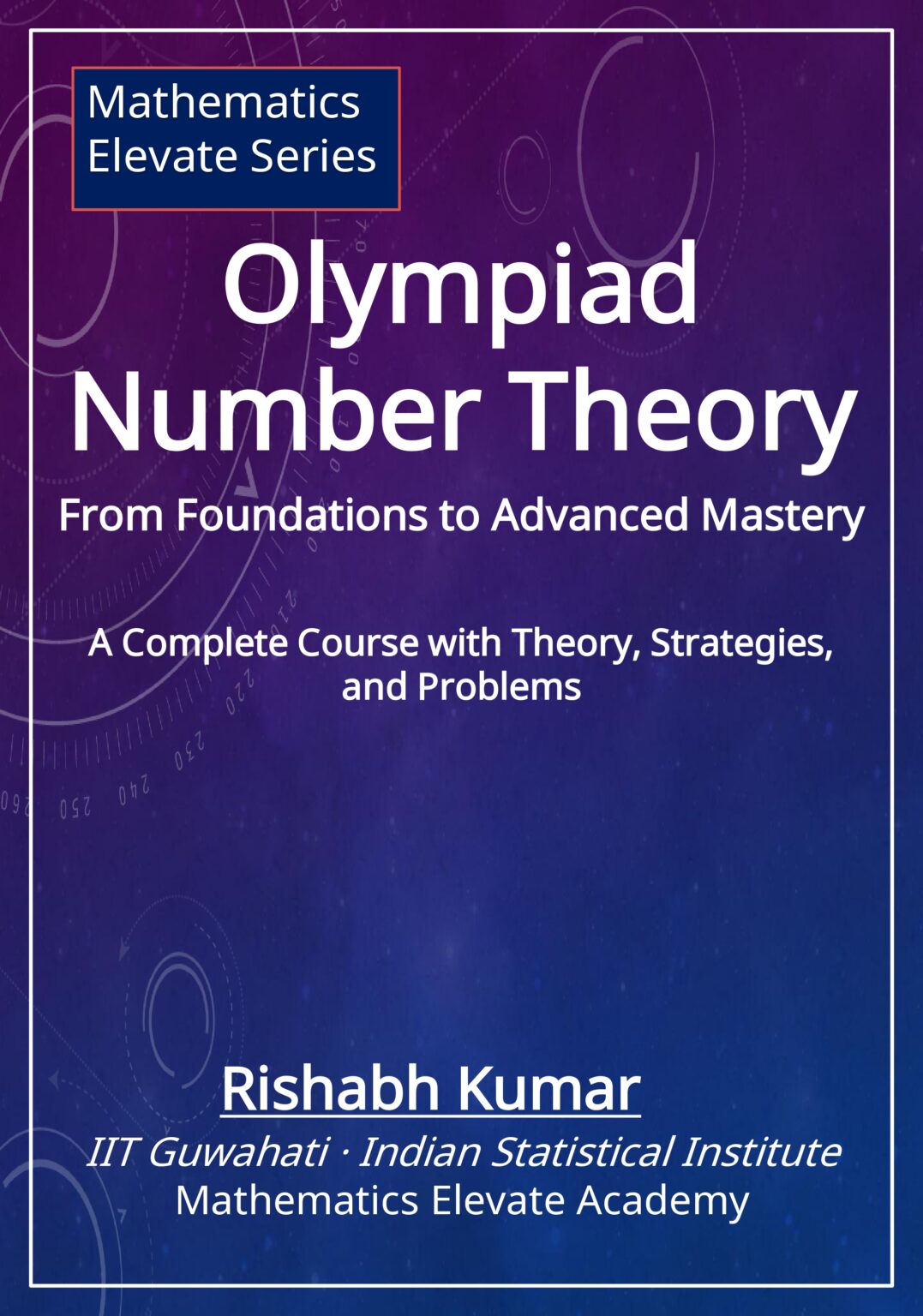
admin I am pleased to announce the release of Olympiad Number Theory, a comprehensive book designed for students preparing for national and international mathematics olympiads, as well as for learners seeking long-term mastery of number theory.
This book is the result of several years of teaching, mentoring, and refining how number theory should be learned: through structure, reasoning, and sustained problem-solving, rather than memorization.
Global Availability
The book is available internationally on Amazon:
United States: https://a.co/d/7PG6tM4
United Kingdom: https://amzn.eu/d/du7plLt
Germany: https://amzn.eu/d/59goQfu
France: https://amzn.eu/d/atq7YC9
Canada: https://a.co/d/fFaLpU0
Australia: https://amzn.asia/d/4uHsHM6
Preview the book:
https://drive.google.com/file/d/1oZtN7CHWGoEQ08_4Rxz68PJDChmxJKTF/view?usp=sharing
Why This Book?
Number theory is often the first area of mathematics where students encounter genuine mathematical thinking. However, many existing resources are either elementary collections of routine problems or advanced references that offer little guidance on how to think through problems.
Olympiad Number Theory was written to bridge this gap. Its primary aim is not only to present techniques, but to develop the ability to recognize structure, select methods, and reason effectively under olympiad conditions.
What Makes This Book Different
The book follows a mentor-driven learning philosophy.
Rather than presenting theory in isolation, chapters are structured around problem patterns, common failure points, and the gradual development of techniques. Each major idea is motivated by the kinds of difficulties students actually face while solving problems.
Throughout the text, explicit guidance is provided on how to approach problems, why certain methods are effective, and where alternative approaches fail. This emphasis on thinking processes distinguishes the book from standard problem collections.
Problems are organized by difficulty, allowing students to build intuition before progressing to olympiad-level and advanced synthesis problems. This structure enables systematic progress without overwhelming the learner.
Scope and Coverage
The book covers the complete olympiad number theory curriculum, including:
- divisibility, gcd, and valuations
- modular arithmetic and the Chinese Remainder Theorem
- lifting techniques, including LTE
- Diophantine equations and descent
- quadratic residues and quadratic reciprocity
- arithmetic functions and Möbius inversion
- continued fractions and rational approximation
- inequalities, extremal methods, and pigeonhole arguments
- Hensel lifting and polynomial congruences
The progression moves from foundational ideas to advanced methods, with careful attention to coherence and continuity.
Intended Audience
This book is intended for:
- students preparing for PRMO, RMO, INMO, IMO, and similar competitions
- advanced school students with strong mathematical interest
- teachers and mentors seeking a structured olympiad resource
- independent learners aiming for deep conceptual understanding
The book can be used for both guided instruction and self-study.
How to Use the Book
Readers are encouraged to study the chapters actively, attempting problems before consulting solutions and reflecting on the reasoning behind each approach. Regular revision of earlier chapters and sustained engagement with mixed problems are strongly recommended.
The final section of the book includes mixed problems that are not organized by topic. This section is designed to train technique recognition and simulate real olympiad problem-solving conditions.
Beyond the Book
Olympiad Number Theory is part of the Mathematics Elevate Series, an initiative focused on long-term mathematical development. Additional enrichment material and mixed problem sets are available through Mathematics Elevate Academy and are intended as optional extensions rather than replacements for the book.
Closing Remarks
This book is not designed for quick completion. It is meant to be studied gradually, revisited, and reflected upon. If it helps students move from searching for formulas to understanding structure and strategy, it will have fulfilled its purpose.
I wish all readers clarity, perseverance, and success in their mathematical journey.
Rishabh Kumar
