
 admin
admin Why This Chapter Matters More Than You Think
Every great mathematical journey begins with a simple question:
“What happens to a function as the input gets very close to a point?”
The entire subject of calculus—differentiation, integration, series, and higher mathematics—rests on the precise understanding of that question. That idea is called a limit. Closely tied to it is the concept of continuity.
I am delighted to present the release of my latest book:
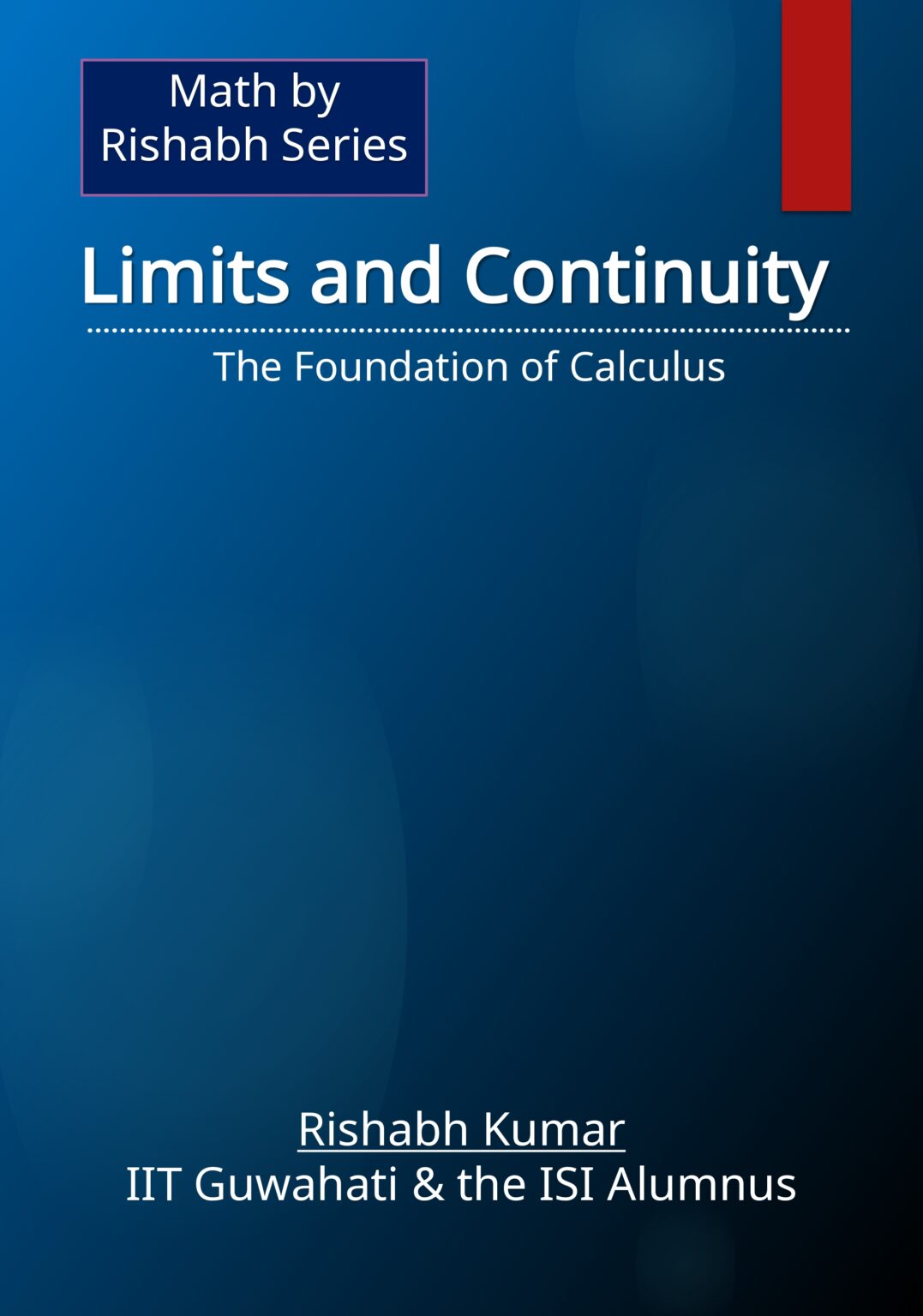
📗 Limits and Continuity: The Foundation of Calculus
A new addition to the Mathematics Elevate Series.
This post explains what the book contains, who it is meant for, and how it can help transform the way students think about calculus.
What Are Limits, Really?
In school mathematics, students often meet limits through formulas likex→0limxsinx=1
or by substituting values into rational expressions.
But limits are far deeper than numerical substitution.
They provide:
- a language to describe changing quantities,
- a framework to handle infinity,
- tools to analyze graphs precisely,
- methods to justify differentiation rules,
- the gateway to rigorous real analysis.
Without limits, calculus becomes a collection of tricks.
With limits, calculus becomes logical.
About the Book
Purpose
The aim of the book is to give students a clean conceptual map of limits and continuity before they step into advanced calculus topics.
Many learners struggle later in calculus because:
- they never understood one-sided limits,
- they confuse limit existence with function value,
- they rely on intuition rather than definitions,
- they have not seen counterexamples,
- they lack algebraic strategy.
This book fixes that at the root.
Highlights of the Book
The text develops the subject through progressive layers.
1. Value of a Function at a Point
The opening sections clarify the distinction between:
- f(a) – the actual value at a point,
- limx→af(x) – the behaviour near that point.
Through careful exposition, students learn cases such as:
- Left-hand limit defined but right-hand not,
- both sides defined but unequal,
- both sides equal but not equal to f(a),
- situations where the limit does not exist.
These logical scenarios are summarized in elegant LaTeX tables and diagrams to serve as quick revision sheets.
2. Fundamental Theorems on Limits
All standard rules are presented with clear conditions:
- Sum Rule
- Difference Rule
- Product Rule
- Quotient Rule
- Constant Multiple Rule
- Power Rule
- Composition Rule
Rather than copying conventional textbook wording, the explanations focus on the mathematical essence:
If individual limits exist finitely, algebraic operations preserve the limit.
The continuity requirement for composition is carefully illustrated so that students do not apply rules blindly.
3. Indeterminate Forms
A crucial chapter deals with expressions whose behaviour is not immediately clear, for example:00,∞∞,0⋅∞,∞−∞
Students are trained to understand that these are not proofs of non-existence, but signals for deeper analysis.
The book discusses general methods such as:
- algebraic restructuring,
- factorisation,
- series expansion,
- comparison of growth rates,
- inequalities and squeeze arguments,
- and later the use of L’Hospital’s Rule.
4. Pathological and Extreme Examples
One of my favourite inclusions is the section on unusual functions.
Readers meet:
- functions that oscillate wildly near a point,
- examples that are continuous but not differentiable,
- removable versus non-removable discontinuities,
- bounded functions with infinitely many discontinuities.
These examples develop a mature intuition:
Mathematics is defined by logic, not by “most graphs.”
5. Advanced Problem Sets
Toward the end, the book transitions into elite-style exercises:
- STEP and TMUA oriented problems,
- graph-based interpretation questions,
- multiple correct choice problems,
- assertion–reason type conceptual drills.
Each exercise is carefully curated to be freshly written and free from any copyright overlap with existing materials.
Who Should Read This Book?
The audience is intentionally broad.
The book is ideal for:
- High school students beginning calculus,
- Engineering and science undergraduates,
- IIT-JEE aspirants needing stronger foundations,
- Teachers looking for structured examples,
- University entrance test candidates,
- and self-learners preparing for advanced mathematics.
If you want confidence in calculus proofs and techniques, this is the starting line.
How This Book Helps Exam Aspirants
Exams like TMUA (Test of Mathematics for University Admission) and Cambridge STEP assume that a student is perfectly comfortable with limit reasoning.
Questions often test:
- dominant behaviour at infinity,
- cancellation of algebraic factors,
- precise understanding of one-sided limits,
- graphical conclusions.
By mastering this book, students gain:
- speed without sacrificing rigor,
- clarity in written explanations,
- confidence in unfamiliar problems.
Format Availability
The book is released in multiple editions to suit different readers.
✔ Kindle Edition – portable digital reading
✔ Paperback Edition – student-friendly size
✔ Hardcover Edition – for libraries and long-term use
Why “Equation Similarity” Is Not a Concern
A common question from new authors is:
“Are mathematical equations copyrighted?”
The answer is explained in the book and in my earlier posts: equations by themselves are not protected; what is protected is the creative presentation and problem selection.
This series is written with complete originality in narrative and exercise design so that educators can use it safely.
Call to Action
Get Your Copy Today
If you are ready to build unshakeable foundations in calculus, explore the book now.
🛒 Buy the Book on Amazon
🇬🇧 UK (Amazon.co.uk): https://amzn.eu/d/iDphOF1
🇺🇸 USA (Amazon.com): https://a.co/d/gfE7ac9
🇦🇺 Australia (Amazon.com.au): https://amzn.asia/d/2QG3cpt
🇩🇪 Germany (Amazon.de): https://amzn.eu/d/5asbWNG
🇨🇦 Canada (Amazon.ca): https://a.co/d/86LAdKc
📌 Other Countries: Search the title and author name on your regional Amazon marketplace.
👀 Preview the Book:
https://drive.google.com/file/d/1bqkwFhCpu_os43MImr8HVtkF7Bb3q70o/view
Explore Courses and Mentorship
Want more than a book?
Visit:
- 🌐 Math By Rishabh: www.MathByRishabh.com
- 🌐 Mathematics Elevate Academy: www.MathematicsElevateAcademy.com
Explore structured courses, exam mentorship, and personalized guidance for TMUA, STEP, MAT, and Olympiad pathways.
Final Words
Limits and continuity are not glamorous topics.
But they are the silent heroes of mathematics.
I hope this book becomes a trusted companion for thousands of students who wish to learn calculus the right way—the logical way.
Happy Learning!
— Rishabh Kumar
Mathematics Elevate Series
